
JBL speakers and headphones
JBL Original vs Fake: 10 Checks for Speakers and Headphones
An original JBL matches JBL's spec sheet for its exact model. Use 10 checks and official specs for 11 models, and see which old tells fail on new models.
Quick answer
An original JBL matches JBL's spec sheet for that exact model and generation. The model exists, it has only the listed ports, and its weight and box contents match. Logo, buttons and labels match JBL's photos of the same model, and a serial shown on both box and device is the same. JBL says fakes differ in cosmetic details, packaging and sound, and usually cost much less. No single check is proof.
Start with checks 1 to 3. A model name JBL never used, an extra card slot or a weight far below JBL's official figure are the clearest warnings. Checks 4 to 10 cover the finish, the box, the serial, the app, the sound and the seller. Many lists copy the tells from JBL's comparison of one older speaker. Since then, the Flip 7 and Charge 6 ship without a cable, and newer spec sheets describe different packaging materials. So each check here says which models it fits and how much it proves, and a table near the end rates them all.
What JBL's own comparison shows, and what has changed
JBL's side-by-side comparison, on its US, Canada, global, Brazil and Argentina pages, photographs one older speaker and its kit beside a fake. The only model it names is the Charge3 power supply, and JBL does not say the tells apply to other models. JBL's Asia-Pacific pages describe the fake a little differently: a stick-on logo, plastic side covers, a barely visible product name and a flimsy box.
Newer models have changed. The Flip 7, Charge 6, Xtreme 4 and Boombox 4 spec sheets describe packaging in FSC-certified paper printed with soy ink, so their boxes may not look like the one JBL compares. Treat every tell as an example from one generation, and compare your item with photos of the same model and generation.
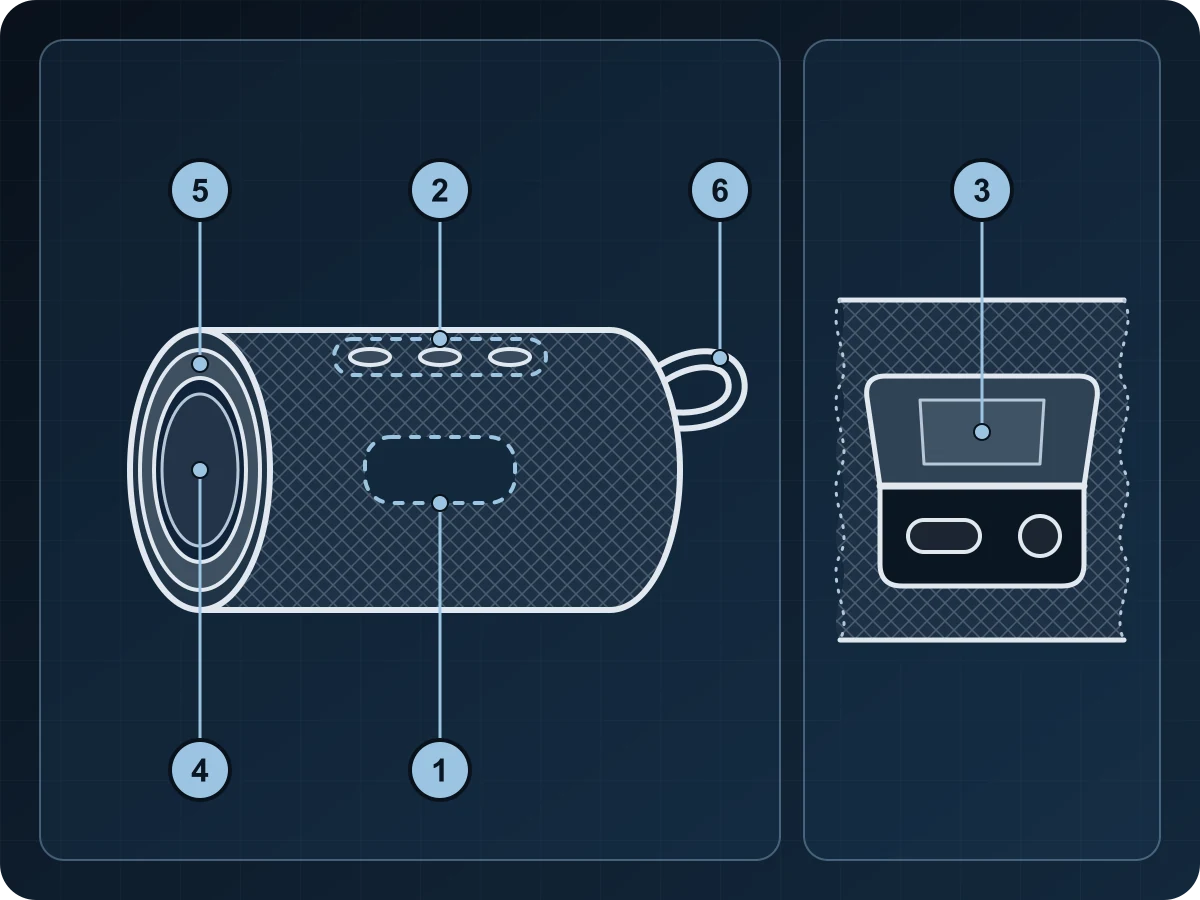
Rodrigo Kniest, president of Harman do Brasil, told Canaltech in September 2026 that some fakes copy the genuine look very faithfully, so no single sign should be judged alone. The checks below refer to the numbers in this diagram.
1. Check that the model exists
JBL Brazil and JBL Argentina say JBL makes no mini products, and name the Boombox mini, Charge mini and Xtreme mini. They also say there is no JBL model called JB950, and no JBL headphones with a memory card or a radio.
Kniest told Canaltech that Harman has found fakes sold as Mini Charge, Mini Xtreme and Mini Boombox. In 2022, Harman do Brasil said the first check is JBL's portfolio on its official channels. Some fakes skip the name altogether: HARMAN said that in 2021, 60% of the fakes it found in Moscow outlets carried no JBL nameplate and copied only the shape.
What to do: search the exact model name on JBL's website for your country. An old model may no longer be listed, so a missing listing needs a closer look, not a verdict. This check is strong when it fails, but a real model name proves nothing, because popular models are the ones copied.
2. Check the ports and features against the spec sheet
Kniest told Canaltech that fakes have offered memory-card slots on models that never had one, and that any input, connection or function missing from the official technical description is an important warning sign.
JBL's US and Canada pages say the flap on the fake they compare sometimes hides an SD card reader (marker 3 in the diagram). Outer Audio, an affiliate review site, says fakes may also add USB-A, aux or SD ports. A Japanese collector's blog says a genuine Flip 6 has a single waterproof USB-C port.
What to do: compare every port, button and light with the spec sheet for your exact model. A card slot, an aux input or any port that is not on the sheet is one of the strongest signs of a fake. Matching ports prove less, because a careful copy can match them too. Some models do have more than one port. The spec sheets list:
- A built-in power bank that charges other devices on the Charge 5 and the Xtreme 4.
- USB-C in and out on the Charge 6 and the Xtreme 4.
- An AC power input plus USB-C on the Boombox 4.
3. Weigh it against JBL's official spec
Kniest told Canaltech that Harman has found a fake about 200 g lighter than the original. Canaltech adds that you must compare with JBL's official weight for exactly the same model and generation. The table gives the numbers from JBL's spec sheets.
The weights are for the item alone. Some sheets also give the weight with the box: 0.32 kg for the Go 4, 0.92 kg for the Flip 6, 1.37 kg for the Charge 6, 3.24 kg for the Xtreme 4 and 8.16 kg for the Boombox 4. Each sheet says specifications can change without notice.
JBL's comparison gives 1.76 lb against 1.32 lb, or 800 g against 600 g on the Brazil page, for an unnamed older speaker. These are examples, not the spec of any model.
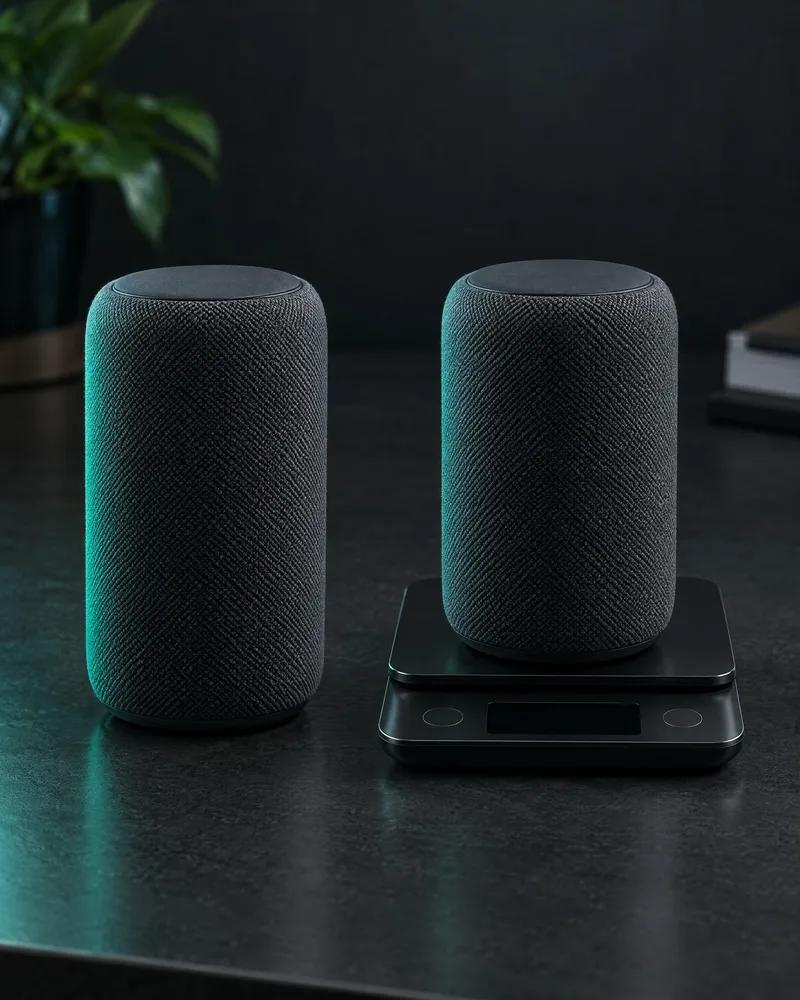
What to do: weigh the item on a kitchen scale and photograph the reading. A weight far below the spec is a strong warning. A weight close to the spec is only a medium sign, and Kniest says weight should not be judged in isolation.
| Model | Weight | IP rating | Charging item in the box |
|---|---|---|---|
| Go 3 | 0.209 kg | IP67 | USB-C cable |
| Go 4 | 0.19 kg | IP67 | USB-C cable |
| Clip 4 | 0.239 kg | IP67 | USB-C cable |
| Flip 6 | 0.55 kg | IP67 | USB-C cable, 1.2 m |
| Flip 7 | 0.56 kg | IP68 | No USB cable (carabiner in the box) |
| Charge 5 | 0.96 kg | IP67 | USB-C cable |
| Charge 6 | 0.96 kg, or 0.99 kg with strap | IP68 | No USB cable (strap in the box) |
| Xtreme 4 | 2.1 kg | IP67 | PD adaptor on the sheet we read; plug varies by region |
| Boombox 4 | 5.89 kg | IP68 | AC power cord |
| Tune 510BT headphones | 160 g | Not rated | USB-C charging cable |
| Tune 520BT headphones | Not on the sheet | Not rated | USB-C charging cable |
5. Check the rubber flap, side covers and passive radiators
On the older speaker in JBL's comparison, the product name is engraved on the rubber flap over the ports, and the flap carries the compliance logos and the serial. The fake's flap has no engraving, and JBL's US page says it is usually blank (marker 3). The Asia-Pacific pages say the fake's name is barely visible.
The Asia-Pacific pages add two tells. The side covers are rubber on the genuine speaker and plastic on the fake. Compliance icons are printed on both sides of the genuine side cover and are missing on the fake (marker 5).
Look at the logo on the passive radiator at each end too (marker 4). It sits in a consistent position on the genuine speaker and out of line on the fake. Outer Audio says skewed parts appear most often around the side radiators. A user on 価格.com, a Japanese price-comparison forum, reported in October 2023 that two fake Go 2 speakers had a plain push-in cover over the charging port, not JBL's shaped waterproof flap.
What to do: open the flap and photograph its inside and both end caps. Layouts differ by model: on the Flip 6, JBL puts the serial on the strap hook, not on the flap.
6. Check the box, the print and what is inside
JBL says the genuine box in its comparison is a hard cardboard box with a flap and no sleeve, with sharper print contrast, detailed textured printing and lifestyle images inside the flap. The fake has a sleeve cover, and the Asia-Pacific pages call it flimsy.
JBL says genuine packaging always shows a serial number, barcode stickers, brand fine print and compliance icons. The fake packaging in its comparison shows none of them.
Two tells apply only to that older kit: the Charge3 power supply weighs 66 g against 41 g for the copy, and the genuine cable was flat and shrink-wrapped. Do not use them on new models.
A convincing box proves little. The European Commission says labels and packaging were among the fake items detained most often in the EU in 2025, and that packaging is shipped apart from unbranded goods and put together inside the EU. A Japanese collector's blog reports fake boxes that print Wireless where the genuine box says Bluetooth, misspell the name as CHRAGE5, or include an aux cable.
What to do: photograph every side of the box, the label with the serial and barcodes, and the contents laid out flat. Besides a quick start guide and a warranty card or safety sheet, the current spec sheets list these items in the box:
- Flip 7 and Charge 6: no USB cable. A missing cable is normal on these two models.
- Flip 6, Charge 5, Go 3, Go 4 and Clip 4: a USB-C cable.
- Xtreme 4: a PD power adaptor, with a plug type that varies by region. The sheet we read is the version with an adaptor, so check the box list for your region before you treat a missing adaptor as a warning sign.
- Boombox 4: an AC power cord.
- Tune 510BT and Tune 520BT: a USB-C charging cable.
7. Find the serial number and compare the box and the device
JBL's US registration form gives the serial format as AB0123-CD4567890, on the product or its box. On the Flip 6 the serial is on the strap hook (marker 6). Canaltech says the serial must match wherever it appears, and that a mismatch between box and device is a reason for suspicion. The same serial on two units is also a warning sign: the 価格.com user above found one serial on both fake Go 2 speakers.
No JBL or HARMAN page we read offers a public serial lookup. Local regulator marks show only that a model was approved: in Brazil, the Anatel seal with a 10- or 12-digit number; in Indonesia, a certificate number, PLG ID and QR code; in the US, the FCC ID. Our JBL serial number guide explains the date letters, where to find the serial and what each register proves.
8. Check the JBL app (supported models only) and the Bluetooth name
Kniest told Canaltech that, on models made to work with the JBL Portable app, an app that does not recognise the speaker or lacks the expected functions is a warning sign. This check only works on models the apps list.
None of the JBL app listings we read says the app checks authenticity. So a model missing from the app is not evidence of a fake, and a speaker the app recognises is not proof that it is genuine.
The Bluetooth name proves little, because third parties can copy the JBL name, as Canaltech notes. ProductNation, a Thai review site, says an odd pairing name such as JBL_Flip5++ points to a fake. In its Boombox 4 guide, Canaltech says trouble syncing a Boombox 4 with other Auracast devices is a sign of a fake.
What to do: on a model the app lists, connect it and take a screenshot, and treat the result as a weak sign either way. The US App Store listings, read in November 2026, show which models each app supports:
- JBL Portable (version 6.9.33): Clip 5, Go 4 and Go 4 DUO, Grip, Flip 3 to Flip 7, Charge 3 to Charge 6, Pulse 2 to Pulse 5, Tuner 3, the Xtreme and Xtreme 2 to 4, and the Boombox and Boombox 2 to 4. It does not list the Go 3, the Clip 4 or older Go and Clip models.
- JBL Headphones (version 5.38.3): includes the Tune 520BT, 525BT and 720BT, Tune Buds and Tune Beam, but not the Tune 510BT, Tune 500BT or Tune 225TWS.
- JBL PartyBox (version 3.14.20): says it does not work with the PartyBox 100, 200, 300, 1000 or On-The-Go.
9. Listen, but do not decide on sound alone
Kniest told Canaltech in 2026 that fakes commonly have less-defined bass and distort as the volume rises, but that bass should not be judged in isolation. Canaltech adds that sound is only an indication, because hearing differs from person to person and fakes vary in quality.
Luciano Sasso, vice president of sales and marketing for consumer audio in South America at JBL Harman, was quoted by Digital Trends en Español in May 2025 saying that imitations bring distorted sound, less-defined bass, missing warranties and electrical-safety problems. JBL says counterfeits usually fail a short time after first use because of poor components.
What to do: play the same track through the speaker at low, medium and high volume and listen for distortion. On headphones, keep the volume at a comfortable level and do not play at full volume while wearing them. A photo review cannot judge sound, and neither can a listing.
10. Check the price and who is selling
JBL says fakes are usually sold at much lower prices than genuine products. A very low price is a warning, but a normal price proves nothing. In February 2024, iMagazine reported that fake Tune 520BT headphones were sold in Poland at prices close to the original, which cost 229 zł in JBL's own store at the time.
JBL's US, Canada and global pages tell marketplace buyers to check who ships and sells the item in the listing, then look for that seller on JBL's authorized dealer list. JBL's Brazil and Argentina pages also tell buyers to check who sells and delivers the item. Our guide to where to buy original JBL lists the sellers JBL names and the official channels by country.
What to do: take a screenshot of the listing with the seller's name and the price. A seller on JBL's list is a strong sign for a new item, but says nothing about a used one.
Flip, Charge, Go, Clip, Xtreme and Boombox: what to check on each model
Each model has its own normal weight, ports and box contents. Find your model below and start there. The figures come from JBL's spec sheets in check 3 and the app lists in check 8.
JBL Brazil and Argentina say there is no mini version of the Charge, Xtreme or Boombox, so a speaker sold under one of those names is a clear warning. HARMAN said in December 2021 that sellers of fakes in Russia preferred older popular models such as the Charge 3, Charge 4 and Boombox. For those older models, compare your item with JBL's own photos of the same model.
- Flip 6: 0.55 kg and IP67, with a 1.2 m USB-C cable in the box. JBL puts the serial on the strap hook, and you may need to remove the strap to read it. The JBL Portable app lists it. A Japanese collector's blog says its logo is metal with orange edging (check 4).
- Flip 7: 0.56 kg and IP68. The box has a carabiner and no USB cable, and that is normal.
- Charge 5: 0.96 kg and IP67, with a built-in power bank and a USB-C cable in the box.
- Charge 6: 0.96 kg, or 0.99 kg with the strap, and IP68. It has USB-C in and out. The box has a strap and no USB cable.
- Go 3 and Clip 4: 0.209 kg and 0.239 kg, both IP67, each with a USB-C cable. The JBL Portable app's US listing, read in November 2026, does not include them, so skip the app check. Both were among the fakes in HARMAN's December 2025 case in Singapore.
- Go 4: 0.19 kg and IP67, with a USB-C cable. Unlike the Go 3, it is on the JBL Portable app's list.
- Xtreme 4: 2.1 kg and IP67, with a power bank and USB-C in and out. The sheet we read lists a PD power adaptor in the box, with a plug that varies by region.
- Boombox 4: 5.89 kg and IP68, with an AC power input plus USB-C, and an AC power cord in the box. Its Bass Boost button lights orange or white. Canaltech says trouble syncing it with other Auracast devices is a sign of a fake.
JBL headphones and earbuds: what to check
The JBL pages we read show no side-by-side comparison for headphones or earbuds. iMagazine reported in February 2024 that JBL released comparison photos of the Tune 520BT in Poland; we have not seen them. Start with the basics: JBL Brazil and Argentina say JBL makes no headphones with a memory card or a radio, so a pair with either is a clear warning.
Compare with the spec sheet. The Tune 510BT weighs 160 g and uses Bluetooth 5.0. The Tune 520BT uses Bluetooth 5.3. Both have a 3.7V/450mAh battery that charges in 2 hours, and ship with a USB-C charging cable, a warranty and warning sheet and a quick start guide. Only the Tune 520BT is in the JBL Headphones app (see check 8).
On Everest BT and Everest Elite NXT on-ear and over-ear headphones, JBL puts the serial on a sticker inside the left side of the headband, seen when the size adjustment is pulled all the way out. On the Everest Elite 100 in-ear model it is on the box only. Tiny earbuds may carry the FCC ID only in the manual and on the packaging or a removable label, which US rules allow for very small devices.
Headphones are copied too. They were 43% of the fakes in HARMAN's 2021 count in Russia, and 8% of the JBL-branded items seized in Brazil in 2021, according to Harman do Brasil.
Headphone Zone, an Indian audio retailer, says a logo with letters other than J-B-L, such as JDL, JBN or JCL, is fake. Headphone Zone and JBL Store PH, a JBL-branded online store in the Philippines, both say wired JBL headphones have an orange lining on the 3.5 mm jack.
What to do: photograph both ear cups, the headband inside and out, the charging port, the charging case for earbuds, and the box label.
How much each check proves
The ratings below are Vereev's reasoning from the sources cited on this page. JBL does not rate its own tells. A fail on a strong check is a serious warning. A pass on a weak check proves little. Many checks that agree make a genuine unit more likely, but they are still not proof, because careful copies can pass them.
| Check | What a genuine unit shows | Worth on its own |
|---|---|---|
| 1. Model | Listed in JBL's portfolio | Strong when it fails |
| 2. Ports and features | Only the ports on the spec sheet | Strong when an extra slot appears |
| 3. Weight | Close to the spec for the same model | Medium |
| 4. Logo and power button | Embedded logo and flush button on the compared model | Medium |
| 5. Flap and side covers | Engraved name and compliance icons | Medium; layouts vary by model |
| 6. Box and contents | Serial, barcodes and icons; contents as on the sheet | Weak alone |
| 7. Serial | The same serial on box and device | Weak alone; strong when it differs |
| 8. App | Recognised, on a model the app lists | Weak either way |
| 9. Sound | Clear bass at higher volume | Weak |
| 10. Seller | On JBL's authorized list | Strong for a new purchase, nothing for a used unit |
Think your JBL is fake? What to do now
Act while you can still return the item. JBL's US, Canada and global pages give these steps. Check the seller on JBL's authorized dealer page, or ask JBL customer service. Ask the seller for a full refund, and give them no more personal information. Report the seller to the platform or payment service. In the US, also report the counterfeit to the FBI's Internet Crime Complaint Center (IC3).
In Brazil, JBL says to return the item, claim a refund and report piracy to monitoramento@harman.com (JBL Brazil page, capture of December 2023). In Poland, JBL said in February 2024, as reported by iMagazine, that you can email serwis@jbl.com.pl with a photo of the serial number and proof of purchase, and JBL will check the item. Our guide to where to buy original JBL has the steps for other countries.
Keep this evidence before you send anything back:
- A screenshot of the listing that shows the seller's name and the price.
- Your order confirmation or receipt.
- Photos of the box label and of the serial on the device.
- A photo of the scale reading, next to JBL's official weight for the model, where JBL's spec sheet gives one.
- Your messages with the seller.
Get an independent second opinion
Vereev reviews a JBL from photos taken with the app's guided checklist. AI assists, and human experts decide. The result is Authentic, Replica, or a statement that the photos cannot settle it, in which case your tokens are refunded. The reviewer may ask for more photos first.
To order, search for JBL in the Vereev app. If your version of the app does not list JBL yet, type the brand name, JBL, and continue. The app shows the cost before you confirm. If you already have an account and tokens, you can also order on the website at /authenticate. Vereev is independent of JBL, HARMAN and Samsung.
What no photo check can prove
No photo check can test sound quality, battery health or electrical safety, and no check at home can test battery health or electrical safety. JBL says fakes can expose users to safety hazards, but it publishes no test data. UL Research Institutes says counterfeiters can fake UL or CE marks, so a mark alone does not prove a product is safe.
Do not open the unit or put it under water to test it. JBL's US warranty does not cover repairs by anyone other than an authorized JBL service center. IP ratings come from standard tests in fresh water under set conditions, and JBL advises rinsing a speaker with fresh water after salt or pool water.
If you are worried about safety or the battery, take the item to an authorised JBL service centre. A Vereev result is an independent opinion from photos. It is not a decision by JBL, and it does not give you a JBL warranty.
Common questions
What readers ask about this topic
How can I tell if my JBL speaker is original?
Check that the model exists, and that the ports, weight and box contents match JBL's spec sheet for the same model and generation. Then compare the logo, flap and labels with JBL's own photos, and the serial on the box with the one on the device. No single check proves it, and even several that agree only make a genuine unit more likely, because careful copies can pass them.
Is there a JBL Charge mini, Boombox mini or Xtreme mini?
No. JBL Brazil and JBL Argentina say there are no mini products in JBL's portfolio, and Harman says fakes are sold under these names.
Do original JBL speakers or headphones have an SD card slot or FM radio?
JBL's Brazil and Argentina pages say JBL makes no headphones with a memory card or a radio. JBL's US and Canada pages say counterfeit speakers sometimes have an SD card reader under the flap, and Harman do Brasil's president says any port that is not in the official spec is a warning sign.
Why did my JBL Flip 7 or Charge 6 come without a charging cable?
Because JBL does not include one. The Flip 7 and Charge 6 spec sheets say the USB cable is not included, so a missing cable is normal on these two models.
How much should an original JBL Flip 6 or Charge 5 weigh?
JBL's spec sheets give 0.55 kg for the Flip 6 and 0.96 kg for the Charge 5, for the speaker alone. Harman says it has found a fake about 200 g lighter than the original, so compare only with the same model and generation.
Does the JBL Portable app prove my speaker is original?
No. None of the JBL app listings we read says the app checks authenticity, and the US App Store listing read in November 2026 did not include the Go 3 or Clip 4 in the JBL Portable app. Harman do Brasil's president says that on a model meant to work with the app, an app that does not recognise the speaker is a warning sign.
Do fake JBL speakers sound worse than original ones?
Often, but not always. Harman do Brasil's president says fakes commonly have less-defined bass and distort as the volume rises, but that bass should not be judged alone. Canaltech adds that sound is only an indication, because hearing differs and fakes vary in quality.
How can I tell if JBL headphones or earbuds are original?
Check the model and its features against JBL's spec sheet, the box contents, the app list for your model, and the serial where JBL gives a location. JBL's Brazil and Argentina pages say JBL makes no headphones with a memory card or a radio.
How can I tell if a JBL Boombox is fake?
On a Boombox 4, check the weight (5.89 kg on JBL's spec sheet), the AC power input plus USB-C, the AC power cord in the box, and the Bass Boost button, which lights orange or white. JBL Brazil and Argentina say there is no Boombox mini. Canaltech says trouble syncing a Boombox 4 with other Auracast devices is a sign of a fake.
My JBL connects but plays no sound, or the app cannot find it. Is it fake?
It can be a warning sign, but a genuine unit can also be faulty. JBL says counterfeits usually fail a short time after first use, and Harman do Brasil's president says it is a warning sign when the JBL Portable app does not recognise a model it lists. The app's US listing, read in November 2026, does not include the Go 3 or Clip 4, so on those models an app failure proves nothing.
Sources and evidence
How this guide was researched
Vereev separates official brand information, established secondary references, first-party product information, and general buyer-safety guidance. Sources support context, not an authenticity verdict for an unseen item.
- JBL Canada: Buy Authentic (read 2 Nov 2026)
Official brand source
- JBL US: Buy Authentic (archive copy, 26 Sep 2026)
Official brand source
- JBL global: Buy Authentic (archive copy, 23 Oct 2025)
Official brand source
- JBL Singapore: Buy Original (read 2 Nov 2026; shared checklist text with the ID, VN, MY, PH, TW and KR pages)
Official brand source
- JBL Brazil: Compre Original (archive copy, 11 Dec 2023)
Official brand source
- JBL Argentina: Compra Auténtico (archive copy, 4 Mar 2024)
Official brand source
- JBL Go 3 spec sheet
Official brand source
- JBL Go 4 spec sheet
Official brand source
- JBL Clip 4 spec sheet
Official brand source
- JBL Flip 6 spec sheet
Official brand source
- JBL Flip 7 spec sheet
Official brand source
- JBL Charge 5 spec sheet
Official brand source
- JBL Charge 6 spec sheet
Official brand source
- JBL Xtreme 4 spec sheet
Official brand source
- JBL Boombox 4 spec sheet
Official brand source
- JBL Tune 510BT spec sheet
Official brand source
- JBL Tune 520BT spec sheet
Official brand source
- JBL Support UK: Flip 6 serial number location (archive copy, 9 Sep 2024)
Official brand source
- JBL Support US: Where is the serial number? Everest headphones (archive copy, 9 Sep 2024)
Official brand source
- JBL Support US: Product Registration (archive copy, 24 Oct 2026)
Official brand source
- JBL Support US: Warranty Information (archive copy, 15 Aug 2025)
Official brand source
- JBL Support Singapore: salt or chlorine water (archive copy, 29 Mar 2024)
Official brand source
- App Store (US): JBL Portable listing (read 2 Nov 2026)
Official brand source
- App Store (US): JBL Headphones listing (read 2 Nov 2026)
Official brand source
- App Store (US): JBL PartyBox listing (read 2 Nov 2026)
Official brand source
- Canaltech: 8 details that give away a fake JBL, with Harman do Brasil's president (5 Sep 2026)
Established secondary source
- Canaltech: how to know if a JBL Boombox 4 is original (4 Oct 2026)
Established secondary source
- Hardware.com.br: JBL seizures in Brazil in 2021, with Harman's statement (Feb 2022)
Established secondary source
- Mobile-review.com: HARMAN's 2021 release on fake JBL goods in Russia (27 Dec 2021)
Established secondary source
- TechCoffeehouse: HARMAN takes down counterfeit JBL speakers in Singapore (15 Dec 2025)
Established secondary source
- Digital Trends en Español: how to recognise a fake JBL speaker and headphones (16 May 2025)
Established secondary source
- iMagazine: how to recognise fake JBL Tune 520 BT headphones (19 Feb 2024)
Established secondary source
- Outer Audio: fake JBL speakers (27 May 2025)
Established secondary source
- ProductNation Thailand: how to check a genuine JBL speaker (10 Jun 2025)
Established secondary source
- European Commission: IPR facts and figures, EU detentions in 2025 (published 20 Oct 2026)
Government source
- 47 CFR 2.925: identification of equipment (eCFR text via Cornell LII)
Government source
- Anatel: guidance on buying homologated devices (Brazil, modified 9 Aug 2023)
Government source
- Permen Kominfo No. 3 of 2024: device certificate labels (Indonesia)
Government source
- UL Research Institutes: how to avoid fake batteries and chargers
Technical reference
- Wikipedia: IP code (summary of IEC 60529)
Technical reference
- Headphone Zone: how to spot an original versus a fake JBL headphone (15 Jun 2022)
Retailer source
- JBL Store PH blog: Is your JBL original? (27 Nov 2018)
Retailer source
- Japanese collector's blog on ameblo: fake JBL speakers, post 1
Reseller report
- Japanese collector's blog on ameblo: fake JBL speakers, post 2
Reseller report
- 価格.com forum: user report on two fake Go 2 speakers (11 Oct 2023)
Reseller report
- Vereev: How to photograph electronics for authentication
Vereev original guidance
- Vereev: How authentication works
Vereev original guidance
- Vereev: Authentication methodology
Vereev original guidance
Read the full Vereev research methodology or request a correction.
Continue your research
Brand guide
JBL Authentication
Read the full guideSample photos
How to Photograph Electronics for Authentication
See the sample photosElectronics authentication
JBL Serial Number Check: Date Code, Labels and Public Registers
Read guideElectronics authentication
Where to Buy Original JBL: Authorized Sellers, Marketplaces and Warranty
Read guideOnline authentication
What Photos Are Needed for Online Authentication?
Read guideItem-level review
Authenticate with Vereev
Use the guide to collect clear evidence, then submit the exact item through Vereev when you need an authentication result and digital certificate.
Vereev is an independent authentication service and is not affiliated with, endorsed by, or sponsored by JBL. Educational guidance cannot replace an item-level review.