
Chow Tai Fook marks
Chow Tai Fook Gold Marks: What 足金, 999, 999.9, 750 and Pt950 Mean
What 足金, 999, 999.9, 750 and Pt950 mean on Chow Tai Fook gold. 足金 is at least 999 in Hong Kong but 990 in mainland China. A stamp is a claim, not proof.
Quick answer
A stamp on Chow Tai Fook gold is a declaration of fineness by whoever applied it, not proof. 足金 means at least 999 in Hong Kong and at least 990 in mainland China. Chow Tai Fook defines 999 as 99.9% gold, 999.9 as 99.99%, 18K as 75% and Pt950 as 95% platinum. 17916 is the name of a 22K product series, so check the separate purity mark.
This guide explains what each mark means on a Chow Tai Fook (CTF) piece, place by place. Hong Kong law was read directly. The text of the mainland standard was not read, so mainland facts rest on press reports, and each is named. This guide does not say whether your piece is real. The real-or-fake guide covers that.
What a mark tells you, and what it does not
A mark is a declaration of fineness by whoever applied it. In Hong Kong, paragraph 4 of Cap. 362A allows three forms: a carat number (optionally with k, c or ct), a fineness in parts per thousand, or the characters 足金.
It lists no maker's mark, brand mark or Au prefix. So a Hong Kong fineness mark says nothing by itself about who made a piece. For mainland China, a consumer guide from Zhejiang consumer councils (Xinhua, 11 September 2026) says a hallmark must include the maker's code, the metal and the purity.
CTF advises buying from reputable merchants, checking the fineness mark and asking for an official receipt, and calls this the strongest defense against fake gold. Daily Business News reported on 22 March 2024 that a forged paper set cost a seller about RMB 20. So read a mark as a claim to check. The real-or-fake guide gives the checks.
Gold marks by place: Hong Kong and mainland China
Always read a mark with its place. The Hong Kong column comes from the First Schedule of Cap. 362A, version dated 12 December 2019. That Order covers articles of at least 8 carats or 333 fineness. The mainland standard's text was not read, so that column rests on press reports.
| Mark | Hong Kong minimum (Cap. 362A) | Mainland China (as reported) | Chow Tai Fook's wording |
|---|---|---|---|
| 足金 | 999 | At least 990‰ | Its Hong Kong guide gives 999 for Hong Kong and 990 for mainland China |
| 999 | 999, the same floor as 足金 | Not confirmed here | 99.9% gold |
| 999.9 | No separate entry | Not confirmed here | 99.99% gold |
| 22K | 916.6 | Not confirmed here | Its mainland site calls the 17916 series 22K |
| 18K | 750 | At least 750‰ (Zhejiang guide) | 75% gold |
| 14K | 585 | Not confirmed here | 58.5% gold |
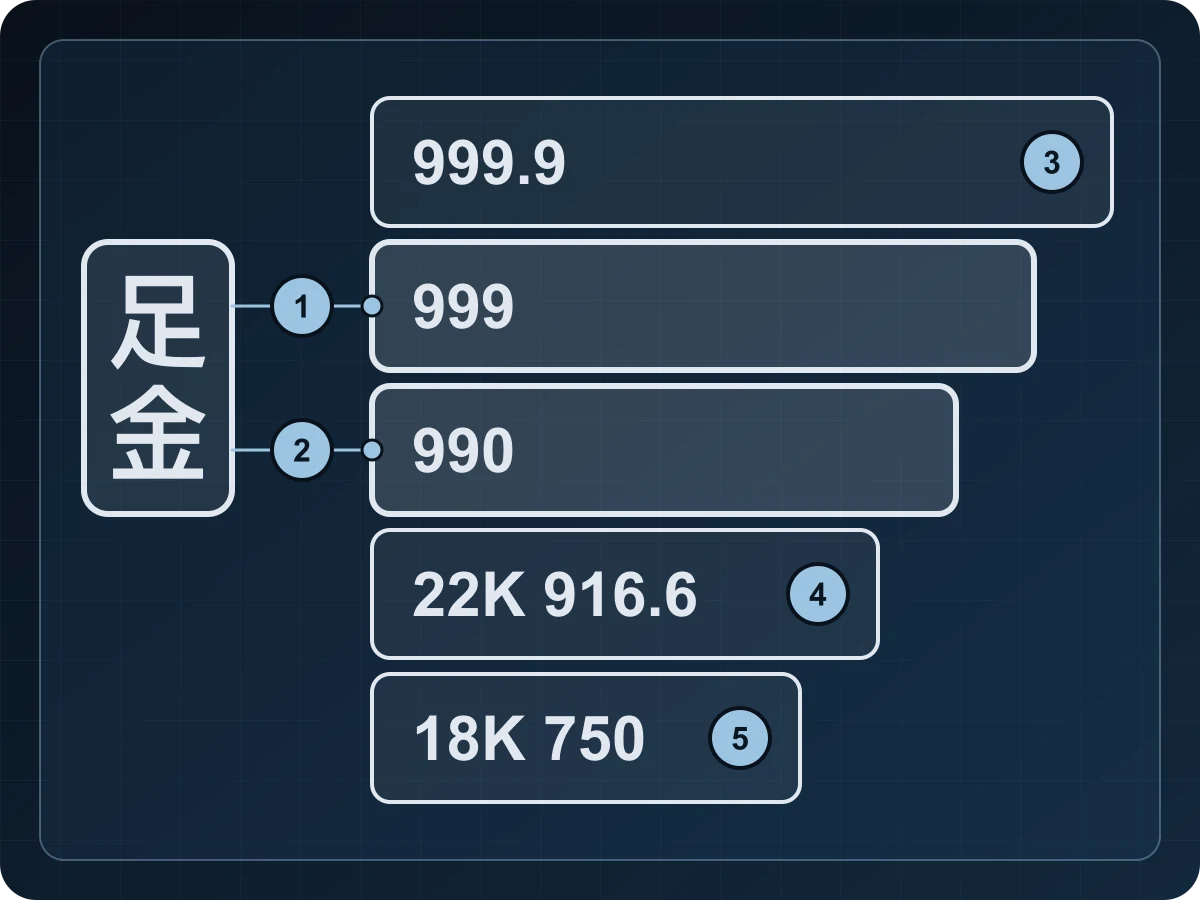
- Lower Hong Kong entries: 15K at 625, 12K at 500, 9K at 375 and 8K at 333.
- Not confirmed means this guide has no source for that mark in that place. It does not mean the mark is wrong.
足金: why the same word has two floors
Hong Kong: L.N. 82 of 2008, made on 8 April 2008, replaced the 足金 figure of 990 with 999. L.N. 270 of 2008 brought this into force on 2 March 2009.
Mainland China: GB 11887-2012 took effect on 1 May 2013. Amendment 1 was approved on 21 February 2015 and took effect on 4 May 2016. The Paper reported on 17 March 2016 that the highest gold name became 足金, at 990‰ or more, and that gold above that may only be labeled 足金. The Zhejiang guide still cites this in September 2026.
Both are right for their place. A Hong Kong piece from before March 2009 was marked under the older figure. These rules set a legal floor for one word. They do not show that gold from one place is purer than gold from the other.
Be careful with any page that gives 足金 as about 83% or 20K. That figure contradicts both places.
999, 999.9, 9999 and Au999: what is the difference?
CTF defines 999 as 99.9% gold and 999.9 as 99.99% gold. Cap. 362A has no separate entry for 999.9.
- 9999: Cailian Press reported on 6 May 2024 that on gold bars, Au99.99, Au999.9 and Au9999 all mean 99.99% and differ only in notation. That report is about gold bars.
- Au999: CTF's guide says genuine 999 gold usually carries Au999 or 足金. The Zhejiang guide tells mainland buyers to look for 足金, 足金999 or Au999. Cap. 362A does not list Au.
- 足金 vs 足金999: in mainland China, 足金 alone claims at least 990‰, and a 足金999 stamp claims 999‰. Cailian Press says firms with an enterprise standard may stamp 足金 999 or 足金 9999 to show content above the national floor.
- Product names: Cnyes reported on 25 February 2015 that 足金和田玉戒指 is a correct product name and 足金999和田玉戒指 a wrong one. Cnyes describes a rule for product names. The amendment's text was not read, so this guide does not say how it applies to stamps.
- 990: in November 2026 a CTF Hong Kong eShop promotion named a 990 Gold charm as a gift. So 990 is not by itself a warning sign, but it is not 足金 under Hong Kong law.
- Au990: CTF's Hong Kong gold purity guide says that in mainland China, gold of 990 parts per thousand (99%) can be called 足金 or Au990. That is below Hong Kong's floor of 999, so Au990 is not 足金 under Hong Kong law. A mark is still only a claim.
- Resale: Cailian Press reported on 6 May 2024 that mainland channels, including ICBC and Chow Tai Fook, told a reporter that gold of 99% or more is bought back at one price, whether sold as 足金, 千足金 or 万足金. This is what a reporter was told, not a published CTF policy.
千足金 and 万足金: are they real grades?
千足金: The Paper reported on 17 March 2016 that Amendment 1 deleted 千足金, 千足铂, 千足钯 and 千足银 and the bracketed 999 figure. The Zhejiang guide says no 千足 advertising. CTF's Hong Kong blog, read on 2 November 2026, uses 千足金 for 99.99%, and Cap. 362A does not contain the term. So its meaning depends on the place and date. Do not treat it as a purity figure.
万足金: a Guangdong testing center expert told Guangzhou Daily in 2016 that it has never appeared in the national standard and is a marketing term. The Zhejiang jewelry trade association advises doubt about inflated purity claims (China Consumer News, 6 February 2025).
916, 17916 and 750: reading 22K and 18K marks
916: in Hong Kong, paragraph 4 of Cap. 362A treats a bare number as a fineness in parts per thousand, so 916 claims 916 parts of gold in 1,000. Hong Kong's minimum for 22K is 916.6. Outside Hong Kong, ask the seller what it means on your piece.
17916: CTF's mainland site describes 周大福17916系列 as a product series made of 22K gold. So 17916 names a collection. The page does not explain the digits, so check the separate purity mark on the piece.
750: CTF's Hong Kong listings use 18K/750, and Hong Kong's minimum for 18K is 750. The Zhejiang guide says 18K gold is at least 750‰, and that its scrap value is about 75% of the same weight of 足金.
A mark is still a claim. China Consumer News reported on 6 February 2025 that in lab tests ordered by the consumer committee of Yongkang, Zhejiang, a necklace sold online as CTF 18K gold had less than 750‰ gold. CTF said the shop was not authorized, and the report does not say whether the necklace was counterfeit.
Pt950 and other platinum marks
CTF defines Pt950 as 95% platinum plus 5% other metals. CTF's platinum guide says jewelers and buyers first check the Pt stamp inside the piece and price by Hong Kong purity standards, and that buyers value platinum by net weight only. It advises checking the scale, cleaning and any fees first.
For mainland China, this guide says nothing firm about platinum marks, because the sources read are press reports only.
- Hong Kong standards (Cap. 362B): 足白金 or 足鉑金 990, PT 990, PT 950, PT 900 and PT 850. Nothing below 850 may be called platinum.
- Hong Kong retail rules (Cap. 362C): articles must be marked PT plus numerals, or 足白金 or 足鉑金, and sold with a receipt. Receipts for 990 or finer must state the weight.
- Exemption: articles too small to mark that weigh under 2 grams. A shop notice and a 3-year record duty also apply.
Where is the stamp on Chow Tai Fook jewelry?
No official photo or description of CTF's maker code, stamp layout or stamp position on gold was found. The only official location statement found is in CTF's platinum guide: jewelers and precious-metal buyers first check the Pt stamp inside the piece. CTF confirms that a maker code and a product stamp exist, not what they look like. Letters such as CTF beside 足金 or 999 therefore cannot be checked against an official picture, and a copy can carry the same letters. Treat any page that claims to show the Chow Tai Fook stamp with care.
CTF's eShop pages show Barcode, Mould No. and Material lines, for example Barcode R38011_000, Mould No. R38011 and Material 999 Gold. The page does not say these are stamped on the piece.
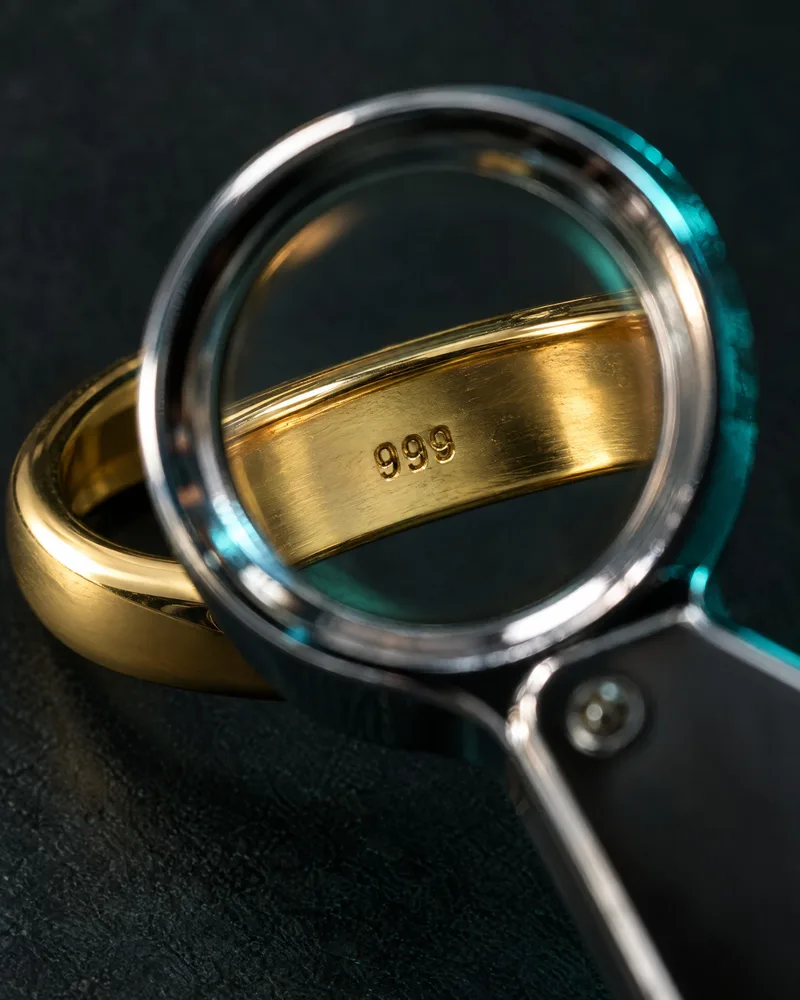
In Hong Kong, each digit or character of the mark must be at least 0.5 square millimeters, so use a loupe. For a Vereev review, photograph every stamp you can find, clasps included. The picture at the top of this page is a Vereev illustration with a generic 999. It is not a Chow Tai Fook stamp.
No mark, tiny pieces, clasps and mixed parts
In Hong Kong, the marking rule (Cap. 362A), which covers gold supplied at retail, does not apply to articles too small or thin to mark that weigh under 1 gram. It also does not apply to coins that are or were currency, medical or industrial articles, gold thread, raw material and bullion including bars, and articles over 100 years old if the receipt says so. So a very small piece with no mark is not by itself proof of a fake in Hong Kong. Ask the seller why it has none, and read what the receipt says.
- Solder: up to 5% of the finished article may be ignored when marking, if it meets a minimum fineness. The minimum is 800 for bodies of 999 or finer, 750 for 916.6, 740 for 750 filigree or watch cases, and 500 for white gold of 750 or 585.
- Mixed fineness: each part is marked, or one mark covers the whole article. Non-gold parts are described on the receipt.
- Gold-treated surfaces: when a gold-treated item is described with gold, 黃金 or 金, the words used with it must be at least as prominent and in the same language.
- Clasps: Guangzhou Daily warned in 2016 that clasps on high-purity pieces can differ in gold content from the body, yet may still be weighed and priced with it.
- Connecting parts: The Paper reported on 17 March 2016 that an analyzer read about 95% silver on chain links between chopsticks stamped S990 in a Shanghai inspection. An official said the whole item must meet the mark. This is a silver case.
What a Hong Kong receipt and shop notice must show
These are the Cap. 362A rules for gold that a trader supplies at retail in Hong Kong. If a receipt from a Hong Kong shop lacks one of these items, ask the seller about it. For mainland China, the Zhejiang guide says to get an invoice showing name, material, purity, weight and price, and to keep invoices, guarantee slips and certificates.
- At the time of supply: the supplier's full name and address, the price, the date, the mark on the article and its fineness.
- Fineness is written in parts per thousand and in carats, and also as 足金 at 999 or above.
- Weight is required when the whole article is 999 or finer.
- The supplier keeps a copy for at least 3 years. Failing to do so is an offense, and on conviction the supplier is liable to a level 2 fine and up to 1 month's imprisonment.
- A prescribed notice at the point of sale must be at least 210 mm by 297 mm, with characters at least 5 mm high.
- At auction, the auctioneer counts as the supplier, and the sale is presumed to be at retail level unless shown otherwise.
Bought outside Hong Kong and mainland China?
The rules above apply to those two places only. No official fineness rules were read for Singapore, Taiwan, Malaysia, Thailand, Vietnam or Japan. So this guide does not interpret marks bought there, including 916.
ISO 9202:2026, published on 20 May 2026, sets recommended fineness ranges for jewelry alloys, and notes that countries may have their own marking laws. Ask a local assay office or jeweler.
If the mark, receipt or weight disagree
A mismatch is a reason to ask, not a verdict. It may be an exempt small piece, a mixed part or an older mark. Photograph the mark and the receipt, ask the seller in writing, and take the piece and papers to a CTF store. Keep the seller's return route open while you wait, and get a second opinion from a lab if the metal is the question. If you think you were deceived, report it to the police, as CTF's statement of 10 May 2024 advises.
In Hong Kong, section 7 of the Trade Descriptions Ordinance bans applying a false trade description to goods or supplying such goods (version dated 24 August 2026). Hong Kong Customs took necklaces and bracelets from two shops for Government Laboratory tests on 4 April 2007, before the 2009 changes. This law was under public consultation in 2026, so check that you are reading the current version. This is not legal advice.
The plain limit: a photo review can read a mark, but it cannot test what the metal is. Looking at the stamp yourself cannot test it either.
Common questions
What readers ask about this topic
What does 足金 mean on Chow Tai Fook gold?
It depends on the place. In Hong Kong, 足金 means at least 999 parts per thousand, a floor in force since 2 March 2009. In mainland China it means at least 990‰, and since 4 May 2016 it has been the highest gold name, after 千足金 was deleted, as The Paper reported on 17 March 2016.
What is the difference between 999 and 999.9 gold?
Chow Tai Fook defines 999 as 99.9% gold and 999.9 as 99.99% gold. Hong Kong's Cap. 362A has no separate entry for 999.9.
Are 足金, 千足金 and 万足金 different grades?
In mainland China the highest gold name is 足金, and Amendment 1 deleted 千足金, as The Paper reported on 17 March 2016. A Guangdong testing expert told Guangzhou Daily in 2016 that 万足金 is a marketing term. CTF's Hong Kong blog, read on 2 November 2026, uses 千足金 for 99.99%, so read that word by place and date.
What does Au990 mean?
Chow Tai Fook's Hong Kong gold purity guide says that in mainland China, gold of 990 parts per thousand (99%) can be called 足金 or Au990. Hong Kong's floor for 足金 is 999, so Au990 is not 足金 there. A mark is only a claim, so ask the seller or a lab if the metal is in doubt.
What does 17916 mean on Chow Tai Fook jewelry?
CTF's mainland site describes 周大福17916系列 as a product series made of 22K gold. So 17916 names a collection. The page does not explain the digits, so check the separate purity mark on the piece.
What is the difference between 足金 and 足金999?
In mainland China, 足金 alone claims at least 990‰ gold, and a 足金999 stamp claims 999‰. The Zhejiang consumer guide tells buyers to look for 足金, 足金999 or Au999. In Hong Kong, 足金 already means at least 999.
What does Pt950 mean?
CTF defines Pt950 as 95% platinum plus 5% other metals. Hong Kong's Cap. 362B lists PT 950 among its platinum standards.
Where is the stamp on Chow Tai Fook jewelry?
No official photo or description of its position on gold was found. The only official statement found is in CTF's platinum guide, which says jewelers and precious-metal buyers first check the Pt stamp inside the piece. Photograph every stamp you can find, clasps included.
Can a fake carry a 足金 or 999 stamp?
Yes. A mark is only a claim by whoever applied it, and reported cases show marks, papers, bags and weight can all pass on a fake. Only a lab test is known to examine the metal.
Why does my small gold piece have no stamp?
In Hong Kong, articles too small or thin to mark that weigh under 1 gram are exempt, so no mark is not by itself proof of a fake there. This guide did not read the rules for other places, so ask the seller or a local assay office.
Sources and evidence
How this guide was researched
Vereev separates official brand information, established secondary references, first-party product information, and general buyer-safety guidance. Sources support context, not an authenticity verdict for an unseen item.
- Hong Kong e-Legislation: Cap. 362A, gold marking order (version dated 12 December 2019)
Government source
- Hong Kong e-Legislation: Cap. 362B, platinum standards
Government source
- Hong Kong e-Legislation: Cap. 362C, platinum marking order
Government source
- Hong Kong e-Legislation: Trade Descriptions Ordinance, Cap. 362 (version dated 24 August 2026)
Government source
- LegCo: L.N. 82 of 2008
Government source
- LegCo: L.N. 270 of 2008
Government source
- Hong Kong Customs: press release on gold testing (2007)
Government source
- Consumer Council: submission of 27 August 2026 (content not read)
Government source
- National Digital Standards Library: GB 11887-2012
Technical reference
- National Digital Standards Library: ISO 9202:2026
Technical reference
- The Paper (17 March 2016)
Established secondary source
- Xinhua: China Consumer News guide from Zhejiang consumer councils (11 September 2026)
Established secondary source
- Cailian Press (6 May 2024)
Established secondary source
- Cnyes (25 February 2015)
Established secondary source
- Guangzhou Daily via Ifeng (2016)
Established secondary source
- China Consumer News on Sina (6 February 2025)
Established secondary source
- Daily Business News via Hangzhou.com.cn (22 March 2024)
Established secondary source
- Chow Tai Fook: How to Distinguish Gold Purity
Official brand source
- Chow Tai Fook: How to Distinguish Gold Purity (Chinese)
Official brand source
- Chow Tai Fook: gold price guide (Chinese)
Official brand source
- Chow Tai Fook: lightweight gold guide (Chinese)
Official brand source
- Chow Tai Fook: year-end gold guide
Official brand source
- Chow Tai Fook: platinum guide
Official brand source
- Chow Tai Fook: Hong Kong home page
Official brand source
- Chow Tai Fook: Official Statement (Hong Kong)
Official brand source
- Chow Tai Fook eShop: 999 Gold product page
Official brand source
- Chow Tai Fook eShop: 18K/750 White Gold product page
Official brand source
- Chow Tai Fook mainland China: 17916 series
Official brand source
- Vereev: How to Photograph Jewelry for Authentication
Vereev original guidance
Read the full Vereev research methodology or request a correction.
Continue your research
Brand guide
Chow Tai Fook Authentication
Read the full guidePhoto guide
How to Photograph Jewelry for Authentication
See how to photograph a stampJewelry authentication
How to Tell if Chow Tai Fook Gold Is Real
Read guideCertificate and code checks
How to Check a Chow Tai Fook Guarantee Slip, Certificate or Serial Number
Read guideGold testing
How to Test Gold at Home: What Torch, Weight and Acid Tests Miss
Read guideItem-level review
Authenticate with Vereev
Use the guide to collect clear evidence, then submit the exact item through Vereev when you need an authentication result and digital certificate.
Vereev is an independent authentication service and is not affiliated with, endorsed by, or sponsored by Chow Tai Fook. Educational guidance cannot replace an item-level review.