
Fake Jellycat safety
Are Fake Jellycats Safe? Risks, Refunds and Where to Report
We found no published test of fake Jellycats, but UK Border Force seized some in 2025. See the warning signs, the label rules and how to get a refund.
Quick answer
Our research found no published safety test of fake Jellycats. UK Border Force seized fake Jellycats in 2025. Its December 2025 release says fake toys can contain banned chemicals and can break and make a child choke. Keep a suspected fake away from children, return it, keep the evidence, and report the seller to the platform and to Trading Standards (UK) or the Commerce Commission (New Zealand).
This page answers two questions: is a suspected fake Jellycat dangerous, and what can you do now. Every risk below is attributed to its source: a regulator, a trade body, Jellycat itself or a retailer, with a date where the source gives one. Figures that cover all brands or all kinds of toy are marked as such, because none of them is a test of fake Jellycats. This page gives no medical or legal advice. If you are worried about a child's health, contact a doctor. To check whether a toy is genuine, use our Jellycat real vs fake guide.
Are fake Jellycats dangerous?
Nobody has published a safety test of counterfeit Jellycats, as far as the research for this page found. Jellycat's Brand Protection Statement says counterfeits leave customers exposed to unsafe soft toys. That is the brand's general position, with no Jellycat test data behind it.
On 23 December 2025, the UK Home Office and Border Force said Border Force had seized counterfeit toys in 2025, including Jellycats. They gave no count, value or port for the Jellycats. The same release says Border Force stopped more than 260,000 counterfeit toys in 2025, and that 90% of them were imitations of the Labubu doll. It names two dangers of fake toys: banned chemicals linked to cancer, and choking when fakes break easily.
The release also says three-quarters of counterfeit toys fail safety tests. The IPO's notes explain that this figure comes from testing in which 21 of 28 counterfeit toys failed. Those were toys of mixed types, so the figure says nothing specific about Jellycat or about plush toys.
The British Toy & Hobby Association (BTHA) says Trading Standards has found counterfeit plush toys stuffed with materials that could cause breathing problems (25 September 2025). It gives no numbers.
In short, counterfeit toys carry real risks, and Jellycat fakes have been seized in the UK. But no test result was found for fake Jellycats as a group, so treat any suspected fake as untested.
Signs a toy is not safe to give a child
Three UK sources describe what to look for when a toy arrives. These signs are about safety, not about who made the toy. To check whether a toy is a genuine Jellycat, use our real vs fake guide.
If you find any of these signs, keep the toy away from children while you decide what to do.
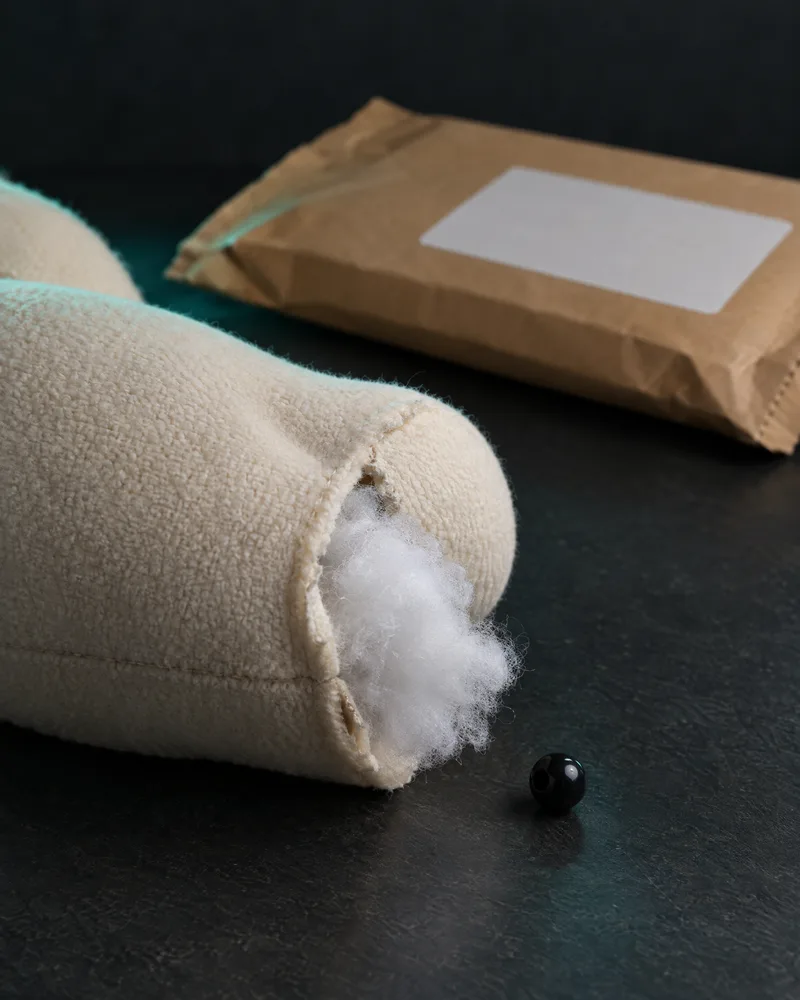
- BTHA red flags: a strong chemical smell, a flimsy feel, stuffing poking through, or loose parts.
- Defects that Gloucestershire Trading Standards found on counterfeit toys seized from one Gloucester shop on 7 October 2025 (the council did not name Jellycat): missing CE marks, missing age warnings on toys with small parts, missing maker and importer names and addresses, eyes that came off easily, and weak seams that gave access to the stuffing.
- The IPO's checks on arrival: a UKCA or CE mark and a UK contact address on the packaging, packaging that looks professional and carries age warnings, and no loose small parts, loose stuffing or unsecured batteries.
What the law requires on a soft toy label
Toy labels follow the law of the country where the toy is sold. The table shows the main rules for Great Britain, the European Union and the United States. A required item that is missing for the place where the toy was sold is a warning sign, but rules differ by country and some details may lawfully sit on the packaging instead of the toy. An item that is present proves nothing, because a copy can print it.
| Place | Rule | Source |
|---|---|---|
| Great Britain: scope and warnings | Covers toys for children under 14. Warnings must be in English and start with the word Warning or Warnings | OPSS guidance, March 2025 edition |
| Great Britain: safety marks | Either the UKCA or the CE mark. CE recognition was extended indefinitely from 1 October 2024 | OPSS guidance |
| Great Britain: identity | An identifier, such as a type, batch, serial or model number, and the maker's name and contact address, on the toy (on the packaging or a document only if the toy's size or nature makes that impossible). UK importers add their own name and address; until 31 December 2027, importers of EEA or Swiss goods may put this on the packaging instead | OPSS guidance on the Toys (Safety) Regulations 2011 |
| Great Britain: toys for under 36 months | For toys clearly meant for children under 36 months, the toy and any detachable parts must be too large to swallow or inhale. Textile toys must be washable, unless they contain a mechanism that soaking would damage, and must stay safe after cleaning to the maker's instructions | Toys (Safety) Regulations 2011, Schedule 2 |
| European Union: CE and tests | CE marking is the maker's own declaration. EN 71-1 covers mechanical properties, EN 71-2 flammability and EN 71-3 the migration of elements such as heavy metals | European Commission, and Intertek, a testing laboratory |
| European Union: from 1 August 2030 | Regulation 2025/2509 applies, and every toy will need a digital product passport | European Commission |
| United States: standard | ASTM F963 is mandatory under CPSIA section 106. Toys made after 20 April 2024 must meet ASTM F963-23 | US CPSC |
| United States: labels | Maker or distributor name and address on the toy or packaging, which may be a website. A permanent tracking label on the product and its packaging. A cautionary label on toys with small parts | US CPSC business guidance |
| Pennsylvania, US | Stuffed toys need a white law label with the maker's Pennsylvania registration number. Not checked on Jellycat labels | Pennsylvania Department of Labor & Industry |
What Jellycat says it tests a genuine toy for
These are Jellycat's own statements about genuine toys. They are not independent tests, and they do not apply to fakes. Jellycat's Corporate Responsibility page says its products are mainly governed by the UK Toy Safety Regulations, the EU Toy Safety Directive, US CPSIA and Health Canada's toy rules. It says all its products are fully tested to EN71, ASTM F-963, ISO 8124 and GB 6675. It says every product is independently tested each year at accredited third-party laboratories, which it does not name.
Jellycat says it tests fabrics for chemicals restricted under REACH, toy safety law, California Proposition 65 and CPSIA. It says all its products are tested as suitable for babies and young children. It adds age guidance where it fits, for longer-pile fabrics or larger items, on the product page and on the sewn label. Its Safety & Care page says products are tested to British, American, European and Australian safety standards, but it names no Australian standard.
So not every Jellycat is meant for every age. Paper Tiger, a UK gift retailer, says some designs are not recommended under 12 months because of fiber shedding, and that some extra-large toys should not go in cribs with small children. Follow the age line on the sewn label where there is one. For advice on safe sleep for a baby, ask your doctor or your national health service.
Jellycat's care advice: most designs can be machine washed on a regular wash and spin cycle at a maximum of 30°C. Larger items can be hand washed or sponge cleaned. Items with structural parts or musical chips should not go in water and should only be wiped with a damp cloth. Jellycat advises against tumble drying, ironing or dry cleaning any of its toys.
Has Jellycat had a recall?
On 3 November 2026, a search for Jellycat in the UK OPSS Product Safety Alerts, Reports and Recalls database returned 0 reports. On the same day, the US CPSC recall database returned no Jellycat match in product names, recall titles or manufacturer names. So no recall was found in these two databases on 3 November 2026. EU Safety Gate, Health Canada and the recall lists of Australia and New Zealand were not checked.
For context, the European Commission said on 9 March 2026 that EU Safety Gate logged a record 4,671 alerts in 2025, up 13%, and that cosmetics and toys made up over half of them. That figure covers all brands.
The IPO advises searching the brand and the product name for recalls before you buy. Repeat the search yourself, because these databases change.
If you think you bought a fake Jellycat: first steps
The UK Intellectual Property Office (IPO) gives these steps if a toy seems fake (October 2025): do not give it to a child, return it, leave a review, report the seller to the platform, and contact Trading Standards. Trading Standards is the UK route. The other steps are general advice.
Jellycat's Brand Protection Statement says Jellycat can only guarantee the safety, quality and ethical standards of a toy bought from an authorized stockist, and that it cannot authenticate counterfeit products that people have bought. It still asks people with a suspected fake to contact its Brand Protection team, through the statement page on its websites.
- Keep the toy away from children.
- Keep the listing, the messages, the receipt or order confirmation, and photos of the toy, the sewn label and the tag.
- Ask the seller or the platform for a return or a refund, using their buyer protection.
- If the seller will not refund you and you paid by card, ask your bank or card provider what it can do.
- Report the seller to the platform where you bought it.
- Report the fake to Jellycat's Brand Protection team.
Refunds and where to report, by country
The research for this page found official routes for the UK and New Zealand only. The table lists them, with who gives each step.
In the UK, Border Force and the IPO work together against counterfeits under Operation Foretide, and seized goods are usually destroyed (GOV.UK, 23 December 2025). In New Zealand, RNZ reported on 18 October 2024 that the Commerce Commission had received five complaints in two weeks about counterfeit Jellycat products, and that they would be investigated. No outcome was reported. IPONZ also told RNZ that businesses convicted of selling counterfeits face fines and penalties.
In other countries, use the platform's buyer protection and contact your local consumer protection authority.
| Where you are | What to do | Who says so |
|---|---|---|
| United Kingdom | Return it, leave a review, report the seller to the platform and contact Trading Standards | UK Intellectual Property Office, October 2025 |
| New Zealand: complaints | Contact the Commerce Commission. The Fair Trading Act bans false or misleading claims about whether products are genuine and where they come from | Commerce Commission, as reported by RNZ, 18 October 2024 |
| New Zealand: refunds | Return the goods for a refund, then contact the Commerce Commission and, if you can, the trademark owner | Intellectual Property Office of New Zealand (IPONZ), as reported by RNZ |
| Anywhere | Report the suspected fake to Jellycat's Brand Protection team | Jellycat Brand Protection Statement |
Getting a second opinion for a refund claim
Jellycat will not authenticate a toy, so a refund claim may need another opinion. Two Auckland buyers told RNZ about their refunds (18 October 2024). One was refunded after a paid online testing service said all eight of her Jellycats were counterfeit. The other found two counterfeit items and was refunded. These are single buyers' accounts, not checked by Jellycat or a regulator.
Vereev gives an independent opinion from guided photos. Authentic and Replica results come with a digital E-Result, a certificate and a QR link that anyone can check at www.vereev-ai.com/verify. Whether a seller or platform accepts it is up to them. If the photos cannot settle it, your tokens are refunded.
LegitApp and LegitGrails, two paid services, also list Jellycat checks. LegitGrails says it is not associated with any brand. Vereev is not affiliated with Jellycat, and no source shows Jellycat endorsing any authenticator.
What no photo review can do: test chemicals, how easily a toy burns, how strong its seams are, or how firmly its parts are fixed. For safety questions, contact Trading Standards in the UK, or the product safety regulator where you live.
Common questions
What readers ask about this topic
Are fake Jellycats safe for babies?
Our research found no published test of fake Jellycats, so nobody can say a given fake is safe. The UK Home Office and Border Force said in December 2025 that fake toys can contain banned chemicals linked to cancer and can break easily and cause choking, so do not give a suspected fake to a baby or child.
Are fake Jellycats toxic?
Our research found no published chemical test of fake Jellycats. The UK Home Office and Border Force said in December 2025 that fake toys in general can contain banned chemicals linked to cancer, and the BTHA lists a strong chemical smell as a red flag. Keep a suspected fake away from children, because a photo review cannot test chemicals.
What should I do if I bought a fake Jellycat?
Keep it away from children, keep the evidence, and return it through the seller or the platform. Report the seller to the platform. In the UK, the IPO also says to leave a review and contact Trading Standards.
Can I get a refund for a fake Jellycat?
Ask the seller or the platform first, using their buyer protection. In New Zealand, IPONZ said deceived buyers should return the goods for a refund. Two Auckland buyers told RNZ they were refunded.
Where do I report a fake Jellycat seller?
Report the seller to the platform where you bought it. In the UK, contact Trading Standards, and in New Zealand, the Commerce Commission. Anywhere, you can report a suspected fake to Jellycat's Brand Protection team.
Can Jellycat help if I bought a fake?
Jellycat says it cannot authenticate counterfeit products that people have bought, and that it can only guarantee the safety, quality and ethical standards of toys from authorized stockists. It does ask people to report suspected fakes to its Brand Protection team.
Has Jellycat ever had a recall?
No recall was found in the UK OPSS database or the US CPSC recall database on 3 November 2026. Recall databases in the EU, Canada, Australia and New Zealand were not checked.
Does a CE or UKCA mark mean a toy is safe?
No. The European Commission describes CE marking as the manufacturer's own declaration that a toy meets EU safety requirements, and a copy can print a CE or UKCA mark. A missing mark is a red flag, but a mark on its own proves neither that a toy is genuine nor that it is safe.
Are all genuine Jellycats suitable from birth?
Jellycat says all its products are tested as suitable for babies and young children, but it adds age guidance to some designs, for longer-pile fabrics or larger items, on the product page and the sewn label. Paper Tiger, a UK retailer, says some designs are not recommended under 12 months. Follow the age line where there is one.
Sources and evidence
How this guide was researched
Vereev separates official brand information, established secondary references, first-party product information, and general buyer-safety guidance. Sources support context, not an authenticity verdict for an unseen item.
- Jellycat US: Brand Protection Statement (archive copy, 4 Jan 2026)
Official brand source
- Jellycat US: Corporate Responsibility (archive copy, 16 Oct 2026)
Official brand source
- Jellycat US: Safety & Care (archive copy, 20 Jul 2026)
Official brand source
- GOV.UK, Home Office and Border Force: counterfeit toys seized in 2025 (23 Dec 2025)
Government source
- GOV.UK, Intellectual Property Office: Fake toys, real harms, with notes to editors (3 Oct 2025, updated 10 Oct 2025)
Government source
- Gloucestershire Trading Standards: more than 200 counterfeit toys seized (10 Oct 2025)
Government source
- GOV.UK, OPSS: Toys (Safety) Regulations 2011 guidance for Great Britain (March 2025 edition)
Government source
- legislation.gov.uk: Toys (Safety) Regulations 2011, Schedule 2
Government source
- European Commission: Toy safety (read 3 Nov 2026)
Government source
- European Commission: Increased action against dangerous products in the EU in 2025 (9 Mar 2026)
Government source
- US CPSC: Toy Safety Business Guidance (archive copy, 12 Jan 2026)
Government source
- Pennsylvania Department of Labor & Industry: Stuffed Toys (read 3 Nov 2026)
Government source
- GOV.UK, OPSS: product safety alerts and recalls, search for Jellycat (3 Nov 2026)
Government source
- US CPSC: recall database search for Jellycat (3 Nov 2026)
Government source
- British Toy & Hobby Association: Fake Toys, Real Harms (25 Sep 2025)
Industry association source
- Intertek (testing laboratory): EU Toy Safety Directive
Technical reference
- Paper Tiger (UK retailer): Jellycat Safety and Care
Retailer source
- RNZ: Consternation grows over alleged counterfeit Jellycat sales (18 Oct 2024)
Established secondary source
- LegitApp (paid authenticator): Jellycat service page
Authentication service
- LegitGrails (paid authenticator): Jellycat legit check
Authentication service
Read the full Vereev research methodology or request a correction.
Continue your research
Brand guide
Jellycat Authentication
Read the full guideMain guide
Jellycat Real vs Fake: 10 Checks and What Each One Proves
Check the toy itselfToy authentication
Jellycat Real vs Fake: 10 Checks and What Each One Proves
Read guideToy buying guide
Where to Buy Genuine Jellycat, and How to Tell if a Shop Is Legit
Read guideItem-level review
Authenticate with Vereev
Use the guide to collect clear evidence, then submit the exact item through Vereev when you need an authentication result and digital certificate.
Vereev is an independent authentication service and is not affiliated with, endorsed by, or sponsored by Jellycat. Educational guidance cannot replace an item-level review.