
Jellycat real vs fake
Jellycat Real vs Fake: 10 Checks and What Each One Proves
How to tell a fake Jellycat: the sewn label, CE mark, batch code, swing tag, size and seams. See what fakes get wrong and how much each check proves.
Quick answer
Start with the seller. Then read the sewn label for care symbols, an address and correct spelling, and measure the toy without ears or tails. Compare the shape, face and fur with official photos of the same design and size. Misspellings, a missing address, a chemical smell or loose parts are red flags. Copies can carry CE marks and batch codes, so no single check proves a toy is genuine.
Jellycat publishes no guide to spotting fakes, and it says it cannot authenticate a toy from images or batch codes. So the checks below come from Jellycat's own pages, UK, EU and US regulators, a UK toy trade body, one Australian retailer, buyers quoted by the New Zealand news outlet RNZ, a legal news report, and one paid authenticator, LegitApp. Each check says how much it can prove. The ratings are Vereev guidance based on those sources, not test results. Have the toy, its label and its tag in front of you.
What each check can and cannot prove
No single check proves a Jellycat is real. A failed check can be a strong warning sign. A passed check usually proves little, because copies can reproduce correct details. Use the table for a quick view, then read each check for its sources.
| Check | What it can show | What it cannot prove |
|---|---|---|
| 1. Seller and price | A strong risk signal, such as an outlet name or a sale over a messaging app | That a toy is fake. A private resale can be genuine |
| 2. Sewn-in label | Red flags, such as no address or a misspelling | That a toy is genuine. A correct label can be copied |
| 3. CE and UKCA marks | A red flag if no mark is present | Anything on their own. Anyone can print a mark |
| 4. Batch code | That an identifier is present, as rules in Great Britain and the US require | Authenticity. There is no public lookup |
| 5. Country of origin | Very little | Anything either way. Jellycat uses factories in several countries |
| 6. Swing tag | Warning signs on recent designs, according to one retailer and one authenticator | Much on older stock, or on a used toy with no tag |
| 7. Shape, face, fur and color | Clear differences from a genuine example of the same design and size | Anything when you compare different designs or sizes |
| 8. Size | A large gap from the official measurements | Small gaps, which can come from how you measure |
| 9. Seams, stuffing and smell | Safety red flags, such as loose parts or a strong chemical smell | That a toy is safe when nothing looks wrong |
| 10. Embroidery, dust bags and sets | A mismatch with Jellycat's official embroidery or event sets | The authenticity of a toy sold without extras |
1. Who sold it, and at what price
Start with the seller. Jellycat's UK trade terms (archive copy of 29 July 2025) bar approved retailers from selling on marketplaces such as Amazon and eBay, through messaging apps such as WhatsApp, or under names with cheap, discount or outlet. Retailers may set their own prices, so a lower price alone does not show that a shop is unapproved. A price far below other listings is still a reason for care. An Auckland buyer told RNZ that a price far below online listings was what first made her suspicious (18 October 2024).
These rules bind approved retailers only, and Jellycat accepts that genuine toys are also resold by third parties, though it cannot verify them. So a marketplace listing or a private resale can still be genuine. Our guide to where to buy genuine Jellycat covers seller checks in full.
How much it proves: a strong risk signal before you pay, but not proof about the toy itself.
2. Read the sewn-in label
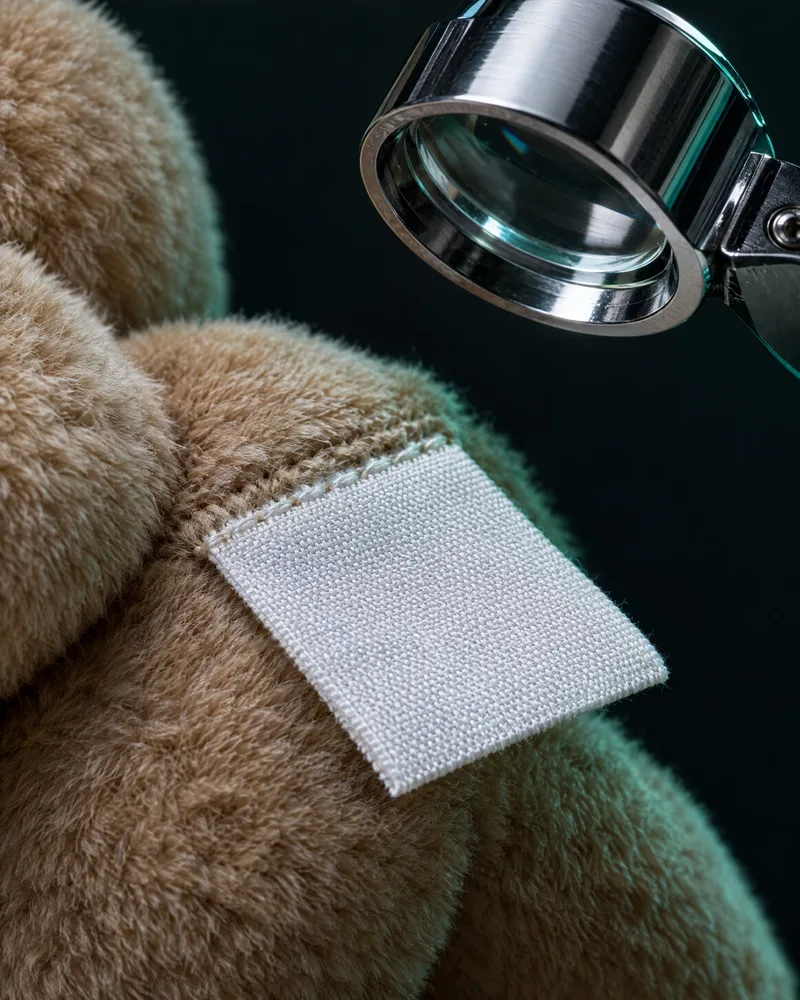
Jellycat says the sewn-in label on each product shows its care instructions as universal washing and care symbols (US Safety & Care page, archive copy of 20 July 2026). It advises against tumble drying, ironing and dry cleaning any of its toys. It also says that in some instances it adds an age recommendation to the label sewn into the product. So a genuine toy may have no age line, and a missing age line proves nothing. Jellycat asks buyers to keep a note of its address, which suggests the label carries a company address. Jellycat publishes nothing else about how the label is laid out or worded.
Rules in Great Britain explain why the address matters. The Office for Product Safety and Standards (OPSS, guidance of March 2025) says a toy maker must put its name, a contact address and an identifier, such as a batch or model number, on the toy, or on the packaging if the toy is too small. Gloucestershire Trading Standards seized fake toys in October 2025 that had no maker or importer name and address. None of those toys was a Jellycat, but the case shows what officials look for.
Spelling and print quality help too. An Auckland buyer told RNZ that the branding on a Lavender Dragon she believed was counterfeit read "I am Lavender Dragom" (18 October 2024). LegitApp describes thin, precise lettering on the wash label of a genuine Bashful Beige Bunny, Birthday version, and calls thick or distorted lettering a warning sign (23 September 2025). On a genuine Ronnie Rockhopper Penguin, it says the wash-label text is printed lighter than the care symbols, while replicas print both at the same weight (28 October 2025).
How much it proves: a missing address, missing care symbols or a misspelling is a red flag. A correct label proves little, because copies can reproduce one.
- Photograph both sides of the sewn label, flat and in sharp focus.
- Check for care symbols and an address, and read every word for spelling.
- Do not worry about a missing age line. Jellycat adds one only to some designs.
3. CE and UKCA marks: Jellycat says real ones have them, and fakes can too
Jellycat's Safety & Care pages say its products carry both the CE mark and the UKCA mark (US page, archive copy of 20 July 2026, and UK page, 21 October 2026). An older help-center answer (archive copy of 16 October 2025) mentions only the CE mark. Neither source says where on the toy or label the marks sit.
A label with only a CE mark is not automatically suspect. Great Britain accepts either mark on toys, and recognition of CE marking was extended indefinitely from 1 October 2024 (OPSS). The European Commission describes CE marking as the maker's own declaration that a toy meets the safety rules. Makers can check their own toys against the standards, so the mark does not show that a test body examined the toy, and anyone can print it on a copy. Gloucestershire Trading Standards found missing CE marks on seized fake toys, so a missing mark is a red flag.
LegitApp describes a placement cue for one design only. It says some fake Snow Dragons have the CE mark upside down or close to the seam (22 October 2025). Do not apply that cue to other designs.
How much it proves: a mark proves nothing on its own. A missing mark is a warning sign.
4. The batch code: why nobody can look it up
Jellycat confirms that its products carry batch codes. Its help center says the codes are used inside the company for quality control and tracking, and are not a way for customers or staff to check authenticity (archive copy of 15 October 2025). Jellycat says it offers no batch-code verification service. A Korean help center that appears to be Jellycat Korea's says the same.
The code exists for legal reasons. Rules in Great Britain require an identifier, such as a type, batch, serial or model number, on a toy (OPSS). In the US, the Consumer Product Safety Commission (CPSC) requires a tracking label with permanent marks on children's products and their packaging. So a batch code is a legal identifier, and a copy can print one too.
Jellycat publishes no location or format for the code. The official Bashful Beige Bunny page showed the product code BAS3B (archive copy of 24 September 2026), but nothing links that code to a label. Do not trust a code decoder, and treat any seller or website that offers a Jellycat batch-code check as unofficial.
How much it proves: nothing about authenticity, whether a code is there or not.
5. Made in China, Vietnam or Indonesia: a weak clue
Jellycat's Modern Slavery Statement for 2024/25 says its core soft-toy ranges are made in Indonesia, Vietnam and Cambodia. It says a small amount of non-core products and promotional merchandise is made in China. It began working with a new supplier in Bangladesh in summer 2024, and it expected production and shipments to start later in 2025. Jellycat says it allows production only at approved sites and does not allow any part of production to be outsourced.
The statement covers one year, April 2024 to March 2025, and says nothing about the wording on labels. So a Made in China line does not mean a toy is fake, and a country that looks right does not prove it is genuine. Older stock may differ.
How much it proves: very little in either direction.
6. The swing tag: what a retailer and an authenticator describe
Jellycat says it has removed single-use plastic bags and tags across all its ranges. It gives no date, so older stock may differ. Jellycat publishes nothing else about its card swing tag.
Send A Toy, an Adelaide shop that calls itself an authorized Australian retailer, described security features on the card tag of newer designs on 12 May 2026. It describes three small raised dots at the bottom right of the front, and a Jellycat logo at the bottom left of the front that shows only under a UV light. It also describes a larger UV-reactive image on the back. It says the features are recent, and that some genuine designs it stocks do not have them. Jellycat has not confirmed this, and our research found no other source that confirms it. Treat a missing feature as a warning sign on recent designs only, never as proof.
LegitApp describes tag cues for single designs. On a genuine Ronnie Rockhopper Penguin, the middle three lines of tag text sit slightly higher, while replicas center them. Replicas also show a paler orange hat on the tag logo (28 October 2025). LegitApp says Yummy Bunny replicas show a wrong-colored hat on the hangtag logo (8 December 2025), and that Snow Dragon fakes show brighter tag colors, mismatched fonts or a misaligned logo (22 October 2025).
How much it proves: a useful warning sign on recent designs. A used toy without its tag proves nothing either way.
- Photograph both sides of the tag, flat and straight on.
- If the design is recent and you have a UV light, look for the features Send A Toy describes. Never shine the light into anyone's eyes.
- Compare fonts and colors only with a genuine tag of the same design.
7. Shape, face, fur and color against the same design
Compare the toy with the photos on the official product page for the same design and size. LegitApp has published cues for several designs. The table shows six of them. They are commercial claims, each for one design, with no public reference photos. Copies can also copy correct details.
Buyers notice texture as well. An Auckland buyer told RNZ that her genuine seagull from the official site had clear wing lines and flat, smooth material, while the one from the shop looked fluffy (18 October 2024).
Color cues do not carry over between designs. A genuine Snow Dragon is white, and LegitApp says a genuine Little Chick is creamy yellow. So judge color only against the same design.
How much it proves: useful when the differences are clear and you compare the same design and size. Weak when you compare different designs.
| Design (LegitApp date) | Genuine, according to LegitApp | Fakes, according to LegitApp |
|---|---|---|
| Snow Dragon (22 Oct 2025) | Firm, even wings, large round black eyes, well-proportioned ears | Floppy wings, smaller eyes hidden by messy fur, ears too small |
| Bashful Beige Bunny, Birthday version (23 Sep 2025) | A plump strawberry on the embroidered cake, a full back, balanced ears | Flat embroidery, a flat back, short or uneven ears |
| Yummy Bunny (8 Dec 2025) | Short neck, longer ears, fluffy layered fur | Longer neck, shorter ears, flat and short fur |
| Little Chick (25 Nov 2025) | Creamy yellow | Noticeably whiter, with different printing on the tags and labels |
| Ronnie Rockhopper Penguin (28 Oct 2025) | A full, rounded embroidered cat-head logo with a well-proportioned orange hat | A flatter logo with an oversized hat |
| Amuseables Peanut Bag Charm (19 Nov 2025) | Smaller and more refined than the fakes LegitApp saw | Noticeably larger, with different fonts and labels |
8. Measure it the way Jellycat does
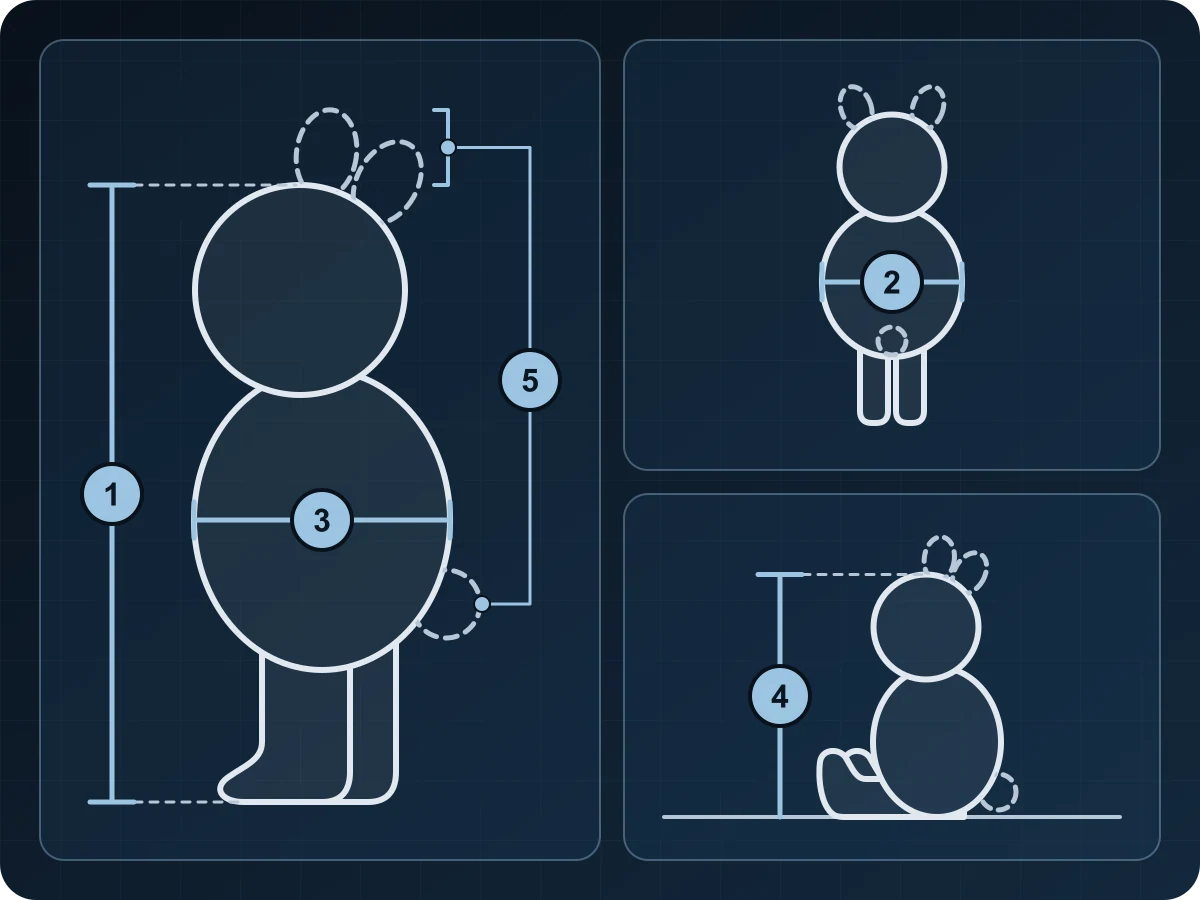
Jellycat's How We Measure page (US site, archive copy of 1 August 2026) says product pages give height, width and length, always in that order. Ears and tails are never included. For many products, including the Bashful Bunny, height runs from the top of the head to the back of the heel. Width is the widest point seen from the back, and length is the widest point seen from the side. Product pages also give a sitting height that leaves out the legs.
Amuseables are measured the same way. Some designs are measured differently: standing dogs such as Munro and Otto, designs that lie flat such as Scrumptious Dragons and Smudges, and designs with tentacles. For a Scrumptious Dragon, length runs to where the stuffed tail starts to curl.
In September 2026, Jellycat's UK product page offered the Bashful Beige Bunny in seven sizes: Tiny, Small, Medium, Large, Huge, Really Big and Giant. Heights for each size were not captured for this guide, so compare your toy with the size shown on the live product page. One size cue from LegitApp is in the table in check 7.
How much it proves: a large gap from the official size is worth a closer look. Measure the way Jellycat does before you decide, because a small gap can come from how you measure.
9. Seams, stuffing, smell and loose parts
The British Toy & Hobby Association (BTHA) lists four red flags when a toy arrives: a strong chemical smell, a flimsy feel, stuffing poking through, and loose parts (25 September 2025). It also says Trading Standards has found counterfeit plush toys stuffed with materials that could cause breathing problems.
Gloucestershire Trading Standards found eyes that came off easily and weak seams that gave access to the stuffing on fake toys it seized in October 2025. None of them was a Jellycat.
Know what genuine filling looks like before you judge. Jellycat says most of its products are made of polyester, and a small number contain cotton or a polyester-cotton blend. It says its stuffing fibre and plastic beans come from specialist suppliers. So some genuine designs contain plastic beans, and beans alone are not a sign of a fake.
How much it proves: these are safety red flags. They do not prove who made the toy, but they are a reason to keep it away from children.
- Pull gently on the eyes and other small parts, and check every seam. Do this away from children. If a part comes off, keep it out of reach of children, keep it as evidence, and do not give the toy back to a child.
- Photograph any seam that is open or weak, and any part that moves.
- If you find a red flag, stop and read our guide to fake Jellycat safety and refunds.
10. Name embroidery, dust bags and event sets
Jellycat's UK and global help center (archive copy of 15 October 2025) says its official personalization embroiders a chosen name in a chosen font and one of 5 thread colors. It is offered on a selection of Bunnies, Jumpers, Soothers, Dragons and an Amuseable. Special characters and emojis are not allowed. It adds about 3 working days to delivery, and personalized items cannot be refunded or exchanged.
Jellycat also warns about people who make Jellycat toys to order from its designs. It says neither Jellycat nor its authorized stockists offer that service. Our buying guide explains how to judge such offers.
Packaging varies on genuine orders. Jellycat's US help center said in October 2025 that orders from its web shop may arrive with a new-design dust bag, the classic one, or both, while old stock is used up. So a mismatched dust bag on an official order is normal.
Event sets have known contents. As of April 2026, each meal at the Jellycat Diner in New York came with the Amuseables plush, an enamel pin in its shape, a sticker sheet, gift packaging with the buyer's name, and a reusable take-out tote. A lone Diner plush resold without the set is evidence neither way.
How much it proves: a mismatch with the official service or set is worth asking about. Missing extras prove nothing on their own.
Dupe, lookalike or counterfeit?
A counterfeit pretends to be Jellycat, with Jellycat's name or labels. A dupe, or lookalike, is sold under another name. The checks in this guide apply to toys that claim to be Jellycat.
Scottish Legal News, citing City AM, reported on 3 September 2026 that Jellycat has filed copyright claims against several UK retailers over alleged lookalike toys. It says the first was filed in June 2024. These are Jellycat's allegations, not court findings. This guide does not list or judge lookalike products.
What these checks cannot prove, and what to do next
No check in this guide, and no photo, proves that a toy is safe. Photos cannot show chemicals, how easily a toy burns or how strong its seams are. And Jellycat says it cannot authenticate a toy for you, as our Jellycat authentication page explains.
For an independent second opinion, photograph the toy in the Vereev app, which guides you through each photo. Search for Jellycat in the app. If your version of the app does not list it yet, type the full name, Jellycat, and continue. AI assists and human experts decide. A reviewer may ask for more photos, and your tokens are refunded if the photos cannot settle it. The app shows the cost before you confirm.
If the toy looks fake, keep it away from children. Use the seller's or the marketplace's return and buyer protection, and keep the listing, the messages, the receipt and your photos. Our guide to fake Jellycat safety and refunds lists where to report a seller in the UK and New Zealand.
Common questions
What readers ask about this topic
How can you tell if a Jellycat is fake?
Check the seller, then the sewn label for care symbols and an address, the swing tag, the size measured Jellycat's way, and the shape, face and fur against official photos of the same design. Misspellings, a missing address, a chemical smell or loose parts are red flags. No single check proves a toy is real.
Do fake Jellycats have a CE mark?
They can. The European Commission describes CE marking as the maker's own declaration, so anyone can print it. Jellycat says its toys carry both the CE and UKCA marks, and Great Britain accepts either one, but a mark proves nothing on its own, while a missing mark is a red flag.
Does "Made in China" mean my Jellycat is fake?
No. Jellycat says a small amount of its non-core and promotional products is made in China, while its core ranges are made in Indonesia, Vietnam and Cambodia. The country line is a weak clue either way.
Where is the batch code on a Jellycat, and can I check it?
Jellycat confirms its toys carry batch codes, but it does not publish where they are or what format they use. It says the codes are for internal quality control and tracking, and it runs no verification service.
Do new Jellycat tags have raised dots or a UV logo?
Send A Toy, an Australian retailer, says newer designs have three raised dots and a UV logo on the front of the tag and a UV image on the back (12 May 2026). Jellycat has not confirmed this, and the retailer says some genuine designs it stocks lack these features, so a missing feature is a warning sign on recent designs only.
My Jellycat came in a different dust bag. Is it fake?
Not for that reason alone. Jellycat's US help center said in October 2025 that orders from its own web shop may arrive with a new-design dust bag, the classic one, or both, while old stock is used up.
Is a Jellycat with an embroidered name genuine?
It can be. Jellycat's UK and global help center says it embroiders names on selected Bunnies, Jumpers, Soothers, Dragons and an Amuseable, in one of 5 thread colors, with no special characters or emojis. Jellycat also says that neither it nor its stockists make Jellycat toys to order.
How do I tell if a Bashful Bunny is fake?
Name the size first: in September 2026, Jellycat's UK page offered the Bashful Beige Bunny in seven sizes, from Tiny to Giant. Measure from the top of the head to the back of the heel, without the ears, compare with the live product page, and read the sewn label for care symbols and an address. For the Birthday version, LegitApp says fakes have flat embroidery, a flat back and short or uneven ears (23 September 2025).
Why is my Jellycat a different size from the website?
Jellycat never counts ears or tails. On many designs it measures height from the top of the head to the back of the heel, and it gives a separate sitting height without the legs. Some designs, such as Scrumptious Dragons, are measured differently. Measure the same way first, and treat only a large gap as a warning sign.
Is a Jellycat dupe the same as a fake?
No. A counterfeit pretends to be Jellycat, while a dupe is a lookalike sold under another name. Scottish Legal News reports that Jellycat has filed copyright claims against several UK retailers over alleged lookalikes. These are allegations, not court findings.
Sources and evidence
How this guide was researched
Vereev separates official brand information, established secondary references, first-party product information, and general buyer-safety guidance. Sources support context, not an authenticity verdict for an unseen item.
- Jellycat Help Centre: Can you authenticate if a Jellycat is real or a fake? (archive copy, 15 Oct 2025)
Official brand source
- Jellycat Help Centre: Can Jellycat check the authenticity of my item using the batch code? (archive copy, 15 Oct 2025)
Official brand source
- Jellycat Korea help center: 정품 여부 (Korean, read 3 Nov 2026)
Official brand source
- Jellycat: Standard Terms & Conditions for retailers, clauses 10.1, 10.8 and 10.9 (archive copy, 29 Jul 2025)
Official brand source
- Jellycat US: Safety & Care (archive copy, 20 Jul 2026)
Official brand source
- Jellycat UK: Safety & Care (archive copy, 21 Oct 2026)
Official brand source
- Jellycat Help Centre: Are Jellycats tested for safety? (archive copy, 16 Oct 2025)
Official brand source
- Jellycat US: How We Measure (archive copy, 1 Aug 2026)
Official brand source
- Jellycat UK: Bashful Beige Bunny product page (archive copy, 24 Sep 2026)
Official brand source
- Jellycat Help Centre: Can a Jellycat be personalised? (archive copy, 15 Oct 2025)
Official brand source
- Jellycat US Help Centre: Dust Bags (archive copy, 7 Oct 2025)
Official brand source
- Jellycat US: Jellycat Diner Experience, New York (archive copy, 26 Apr 2026)
Official brand source
- Jellycat US: Corporate Responsibility (archive copy, 16 Oct 2026)
Official brand source
- Jellycat: Modern Slavery Statement 2024/25 (archive copy, 18 Oct 2026)
Official brand source
- Jellycat US: Brand Protection Statement (archive copy, 4 Jan 2026)
Official brand source
- GOV.UK, OPSS: Toys (Safety) Regulations 2011 guidance for Great Britain (March 2025 edition)
Government source
- European Commission: Toy safety (read 3 Nov 2026)
Government source
- US CPSC: Toy Safety Business Guidance (archive copy, 12 Jan 2026)
Government source
- Gloucestershire Trading Standards: more than 200 counterfeit toys seized (10 Oct 2025)
Government source
- British Toy & Hobby Association: Fake Toys, Real Harms (25 Sep 2025)
Industry association source
- RNZ: Consternation grows over alleged counterfeit Jellycat sales (18 Oct 2024)
Established secondary source
- Scottish Legal News: Jellycat copyright claims against UK retailers over alleged lookalike toys (3 Sep 2026)
Established secondary source
- Send A Toy (Australian retailer): how Jellycat is fighting back against fakes (12 May 2026)
Retailer source
- LegitApp (paid authenticator): How to legit check the Jellycat Snow Dragon (22 Oct 2025)
Authentication service
- LegitApp: Ronnie Rockhopper Penguin authentication guide (28 Oct 2025)
Authentication service
- LegitApp: Bashful Beige Bunny Birthday real vs fake (23 Sep 2025)
Authentication service
- LegitApp: How to legit check the Jellycat Yummy Bunny (8 Dec 2025)
Authentication service
- LegitApp: How to authenticate the Jellycat Little Chick (25 Nov 2025)
Authentication service
- LegitApp: How to authenticate the Jellycat Amuseable Peanut Bag Charm (19 Nov 2025)
Authentication service
- Vereev: How to photograph collectibles for authentication
Vereev original guidance
Read the full Vereev research methodology or request a correction.
Continue your research
Brand guide
Jellycat Authentication
Read the full guideSample photos
How to Photograph Collectibles for Authentication
See the sample photosToy buying guide
Where to Buy Genuine Jellycat, and How to Tell if a Shop Is Legit
Read guideToy safety
Are Fake Jellycats Safe? Risks, Refunds and Where to Report
Read guideOnline authentication
What Photos Are Needed for Online Authentication?
Read guideItem-level review
Authenticate with Vereev
Use the guide to collect clear evidence, then submit the exact item through Vereev when you need an authentication result and digital certificate.
Vereev is an independent authentication service and is not affiliated with, endorsed by, or sponsored by Jellycat. Educational guidance cannot replace an item-level review.