
Oakley lenses
Oakley Lens Etching: Which Logos, Marks and Stickers Are Normal
Oakley says only its prescription lenses carry a laser-etched O. What Prizm and Polarized etching, a static P and stickers mean, and what lens tests prove.
Quick answer
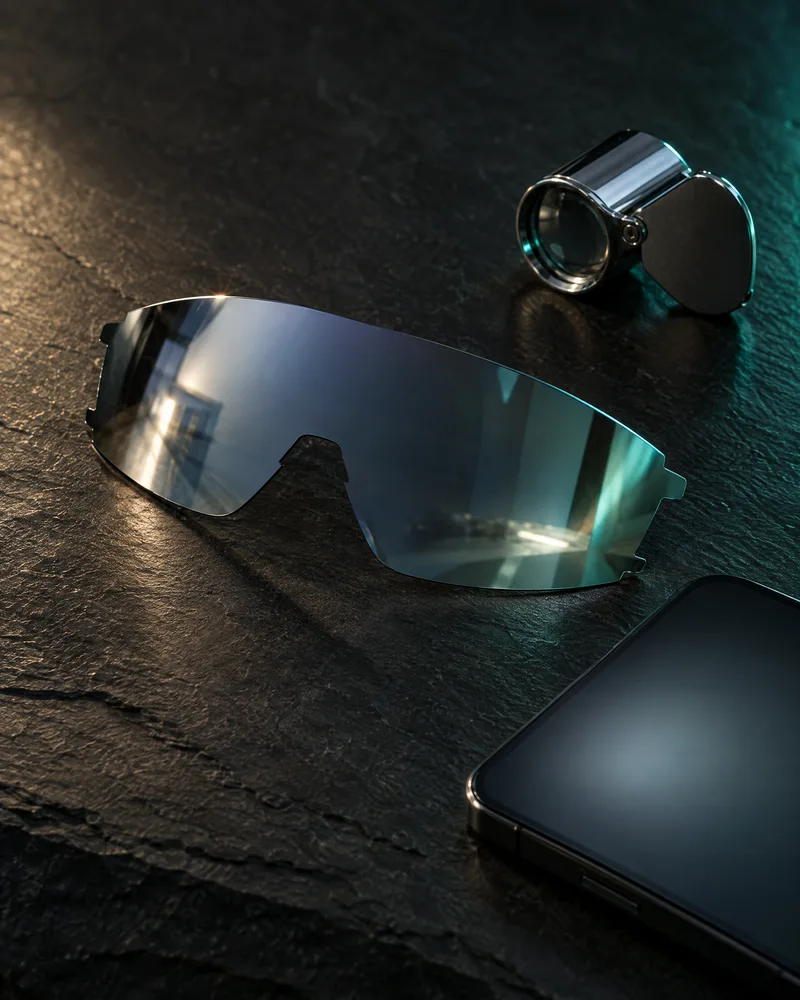
Oakley says only its Authentic Prescription lenses come laser-etched with the Oakley O, and Oakley Custom can etch logos. Retailers such as EZContacts say standard lenses may carry etched labels like PRIZM, and polarised lenses a static-cling P. FramesDirect and others call a painted O, an adhesive sticker or a Genuine Oakley sticker a warning sign. No home test can confirm a Prizm dye or UV protection.
Guides contradict each other on the lens O. Some say Oakley never puts a logo on a lens. Others say every genuine lens has one. Oakley's own words show that both are wrong. This guide starts from what Oakley says, sets out what each retailer claims under its name, and ends with what lens tests can and cannot prove.
Do real Oakleys have an O on the lens?
Only some do. Oakley's Lens Technology page says only Oakley Authentic Prescription lenses come laser-etched with the Oakley O, which Oakley calls proof of authenticity. That is Oakley's description of its own lenses: an etch seen in a photo is one sign, not proof. EssilorLuxottica's 2025 filing also describes a laser-etched O signature on Authentic Prescription lenses. The Lens Technology page says nothing about marks on non-prescription lenses.
EZContacts says an etched O belongs only on prescription lenses from Oakley or an authorised retailer. Revant says that on prescription lenses it may sit in a lower corner.
Two common claims go too far. EyeBuyDirect says Oakley puts no logo on any lens, but Oakley etches its O on prescription lenses, and Oakley Custom etches logos. Underpriced, a reseller app's blog, says genuine lenses carry an etched O, but Oakley names only prescription lenses.
Prizm, Polarized and special-edition etching
Retailers say many standard lenses carry small etched labels. EZContacts says genuine non-prescription lenses often have tech labels etched on the bottom edge, such as PRIZM, POLARIZED or PRIZM P. Feel Good Contacts says Prizm pairs carry PRIZM, POLARIZED or PRIZM P etching, and non-Prizm pairs carry none. The Sunglass Fix puts the Prizm logo at the bottom left of the left lens or the top right of the right lens. No Oakley page gives positions, so position alone is not a test.
Revant lists other genuine etchings. Ballistic and Industrial lenses can carry a small etched O. Some shield lenses, such as the M Frame, have an etched Oakley above the nose bridge. Limited editions, such as Tour de France, MLB, Ferrari and a breast cancer edition, carry other etchings.
Oakley Custom can etch a team or business logo onto lenses. So an etched logo on a Custom pair is not by itself a fake sign.
Stickers: what retailers call normal, and why an authenticity sticker is a warning sign
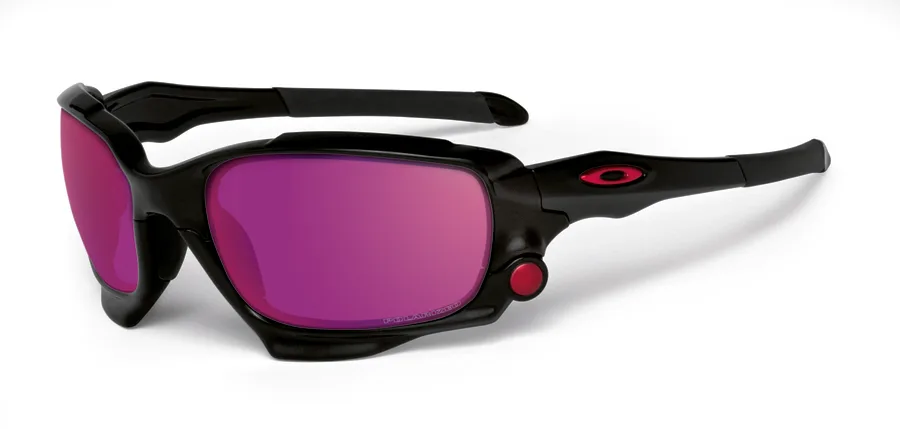
Revant, Feel Good Contacts, EZContacts and EyeBuyDirect say a genuine polarised lens may carry a static-cling P, but never an adhesive sticker that leaves residue. FramesDirect, an EssilorLuxottica shop, says a painted O, a permanent sticker or glue residue is not normal on Oakley lenses.
Heavyglare, a self-described authorised dealer, wrote in 2012 that Oakley does not put Genuine Oakley or 100% Authentic stickers on its sunglasses. A sticker that says the pair is genuine is a warning sign.
Do not scrape a mark to test it. Oakley's Product Care page says Iridium is a 12-micron coating that needs care to avoid scratches.
Is it really Prizm? Lens names Oakley uses
No photo or home test can confirm a Prizm dye. You can check two things. Feel Good Contacts says Prizm pairs carry a PRIZM, POLARIZED or PRIZM P etching and non-Prizm pairs carry none, so a pair sold as Prizm with no etching at all deserves a closer look. The lens name in the listing should also be one Oakley uses, though Oakley's own list below is not complete. Oakley says Prizm dyes enhance colour and contrast, with versions for sport, snow, trail and everyday wear. These are brand claims.
Oakley's Prizm page lists lens names such as Grey Gradient, Black Polarized, 24K and Sapphire Iridium Polarized for everyday wear. For sport it lists names such as Road Black, Trail Torch, Field and Deepwater, and for snow Black Iridium, Torch Iridium, Hi Pink and Persimmon. It is not a full catalogue: the Oakley Meta guides add names such as Prizm Daily, Prizm Slate and Prizm Sapphire. An unfamiliar name is not proof either way.
Oakley uses other lens terms too, all brand claims. It says every sunglass lens it makes is Plutonite, with UV protection built into the material, designed to filter 100% of UVA and UVB up to 400 nm. It calls Iridium a metal coating that reflects light. It also names HD Polarized, High Definition Optics and XYZ Optics.
Swapped and replacement lenses
Oakley's US FAQ says Polarized replacement lenses fit frames that came with non-polarized lenses. Oakley sells replacement lenses only as a left-and-right pair, and it does not sell a frame alone: a defective frame is replaced free under warranty, or for a nominal charge outside it.
So a single lens, or a frame-only listing, is not how Oakley sells parts. A private owner can still sell a frame without its lenses, so this is not a fake test. Revant says legitimate sellers sell real frames with aftermarket lenses when the listing says so.
Lenses also affect the warranty. Oakley Australia says fitting non-Oakley lenses voids its warranty, and the Oakley Meta guides say non-authentic replacement lenses void theirs. Buyers quoted by BikeBiz in 2018 reported that fake lenses and parts fit genuine frames, so a genuine frame can carry fake lenses.
The phone screen test: what polarisation shows
A common home check is to look at a bright phone screen through the lens and slowly turn the lens a quarter turn. If the screen goes darker at one angle, the lens may be polarised. Even then, the test cannot show who made the lens. Copies can be polarised too: in May 2019, Chilean customs stopped 1,000 fake polarised glasses imitating the Oakley Radarlock, AduanaNews reported.
The standard asks for more than a home test can see. ISO 12312-1:2022 says lenses claimed to be polarising must exceed 78% polarising efficiency in categories 2 to 4, and 60% in category 1. The transmission plane must sit within 5 degrees of vertical, and the two lenses within 6 degrees of each other. No home test measures this.
The American Academy of Ophthalmology adds that polarisation cuts glare but does not itself block UV.
Do fake Oakley lenses block UV?
You cannot tell by looking, and no lab study of Oakley counterfeits was found. An optician can measure UV blocking in seconds, as explained below. Chile's Iquique customs director said on 12 November 2024 that the sunglasses seized there do not even filter UV, but showed no test data and did not single out the Oakley copies. BikeBiz reported in 2018 that a buyer had fake Oakleys tested in a hospital lab, where they blocked UVA and UVB.
The American Academy of Ophthalmology says to look for a label promising 100% UV protection, and that labels reading "UV absorption up to 400nm" are also acceptable. It says darker lenses are not necessarily more protective, coloured and mirror lenses add no UV protection, and an optical shop can test UV. All About Vision (updated 24 February 2026) says an eye-care professional can test UV blocking in seconds with a photometer, and that colour and darkness say nothing about UV.
Labels use different yardsticks. ISO 12312-1 measures UV-A only up to 380 nm, while UV400 labels and Oakley's own wording use 400 nm. In the US, FDA guidance from 1998 says an untrue claim to block 100% of UVA, UVB and UVC makes a pair adulterated under US rules.
UV blocking matters more than tint. A 2024 study in Scientific Reports by Masili, Duarte and Ventura modelled 214 sunglass lenses. It found that lenses with UV-A protection below 86% may have a slight potential to raise the hazard to the eye compared with wearing no sunglasses. For advice about your own eyes, ask an optician.
What lens category 0 to 4 means
ISO 12312-1:2022 sorts general-use sunglass lenses into five categories by how much visible light they let through. Lenses sold for road use must be category 0 to 3.
The College of Optometrists, citing the 2013 text, says lenses that let through less than 75% of light must not be used for driving at twilight or night. The 2022 text lets neighbouring categories 0 to 3 overlap by up to 2 percentage points, doubled for gradient tints, so one reading just outside a band proves nothing.
Oakley Meta glasses print their category and filter type as a number and a letter, which the Oakley Meta guide explains. The Oakley Meta guides also list which Prizm colours suit road use, but that list applies to Oakley Meta lenses only. We found no Oakley document saying whether standard Oakley sunglasses carry the same category mark.
| Category | Visible light let through | Driving |
|---|---|---|
| 0 | Above 80% | Can be suitable for road use |
| 1 | Above 43% to 80% | Can be suitable for road use; not at twilight or night if under 75% |
| 2 | Above 18% to 43% | Can be suitable for road use by day only |
| 3 | Above 8% to 18% | Can be suitable for road use by day only |
| 4 | Above 3% to 8% | Never for driving |
If the lens marks look wrong, or you are not sure
The limit first: a photo shows marks on a lens. It never shows UV protection, polarising efficiency or impact resistance. Then take these steps:
- Ask an optician to measure UV blocking. The American Academy of Ophthalmology says an optical shop can test it, and All About Vision says an eye-care professional can do it in seconds with a photometer.
- Photograph each lens at a slight angle to the light, as the Vereev eyewear photo guide suggests, and add a close-up of the lower edge.
- Send those photos, the temple print and where you bought the pair to Oakley Customer Care, using the route your country's Oakley site gives at oakley.com/contact, or send them for a Vereev photo review.
- If you were sold fakes, use the seller's or marketplace's returns and report the seller on Oakley's Report Fakes form.
Common questions
What readers ask about this topic
Do real Oakleys have the O on the lens?
Only some. Oakley says its Authentic Prescription lenses come laser-etched with the Oakley O, and Oakley Custom can etch logos. FramesDirect says Oakley does not print the O on non-prescription lenses and calls a painted O not normal.
Where is the Prizm logo on Oakley lenses?
Oakley does not say. EZContacts says tech labels such as PRIZM are etched on the bottom edge, and The Sunglass Fix says the bottom left of the left lens or the top right of the right lens. Position alone is not a test.
Do real polarized Oakleys have a P sticker?
They may have a static-cling P, according to Revant, Feel Good Contacts, EZContacts and EyeBuyDirect. They say a genuine lens never has an adhesive sticker that leaves residue.
Is a Genuine Oakley sticker on the lens a bad sign?
Retailers treat it as a warning sign. Heavyglare, a self-described authorised dealer, wrote in 2012 that Oakley does not put Genuine Oakley or 100% Authentic stickers on its sunglasses, and FramesDirect says a permanent sticker or glue residue is not normal.
Can my phone screen tell me if Oakley lenses are real?
No. Turning a lens over a phone screen can show whether it is polarised, not who made it. Chilean customs stopped 1,000 counterfeit polarised glasses imitating Oakley Radarlocks in 2019, so fakes can be polarised too, and no home test measures polarising efficiency.
Can I test the UV protection of my Oakleys at home?
Not reliably. All About Vision says lens colour and darkness say nothing about UV, and that an eye-care professional can test it in seconds with a photometer.
Can a real Oakley frame have fake lenses?
Yes. Buyers quoted by BikeBiz said fake lenses fit genuine frames, and Revant says real frames are also sold with aftermarket lenses when the listing says so. Oakley Australia says non-Oakley lenses void the warranty.
What does category 3 mean on sunglasses?
Under ISO 12312-1:2022, a category 3 lens lets through above 8% to 18% of visible light. It can be suitable for road use by day, but the College of Optometrists says lenses under 75% must not be used for driving at twilight or night.
Sources and evidence
How this guide was researched
Vereev separates official brand information, established secondary references, first-party product information, and general buyer-safety guidance. Sources support context, not an authenticity verdict for an unseen item.
- Oakley Lens Technology
Official brand source
- Oakley Prizm
Official brand source
- Oakley US FAQ (Custom etching, replacement lenses)
Official brand source
- Oakley EU FAQ (Custom etching)
Official brand source
- Oakley Product Care
Official brand source
- Oakley Australia warranty (Australia and New Zealand)
Official brand source
- Oakley Meta HSTN Safety and Warranty Guide (PDF)
Official brand source
- Oakley Meta Vanguard Safety and Warranty Guide (PDF)
Official brand source
- Oakley: Report Oakley Product Fakes
Official brand source
- EssilorLuxottica Universal Registration Document 2025 (PDF), p. 54
Official brand source
- ISO 12312-1:2022 preview (iTeh): sunglasses for general use
Technical reference
- College of Optometrists: tints and driving (UK)
Industry association source
- American Academy of Ophthalmology: choosing sunglasses
Industry association source
- All About Vision: how to tell if sunglasses have UV protection (updated 24 February 2026)
Established secondary source
- Masili, Duarte and Ventura, Scientific Reports 14:6604 (19 March 2024)
Technical reference
- US FDA: guidance for nonprescription sunglasses (1998, US)
Government source
- Servicio Nacional de Aduanas de Chile: 84,000 fake sunglasses seized (12 November 2024, Spanish)
Government source
- AduanaNews: Chile stops fake Radarlock glasses (7 May 2019, Spanish)
Established secondary source
- BikeBiz: why cyclists buy fake Oakleys (28 May 2018)
Established secondary source
- Revant Optics: How to spot fake Oakleys
Retailer source
- Revant Optics: How to spot fake Oakley Holbrooks
Retailer source
- FramesDirect (EssilorLuxottica-owned): Are my Oakleys fake? (updated 12 October 2026)
Retailer source
- EyeBuyDirect (EssilorLuxottica-owned): How to tell if Oakleys are real (3 March 2025)
Retailer source
- EZContacts: How to tell if Oakleys are real (16 September 2026)
Retailer source
- Feel Good Contacts: How to spot fake Oakley sunglasses (10 June 2026)
Retailer source
- The Sunglass Fix: How to tell if Oakley sunglasses are real (8 March 2024, UK)
Retailer source
- Heavyglare Eyewear: Frogskins fakes (6 December 2012)
Retailer source
- Underpriced: Is Oakley worth reselling? (2026)
Reseller report
- Photo: Luxottica, CC BY-SA 3.0, via Wikimedia Commons
Technical reference
- Vereev: How to Photograph Sunglasses for Authentication
Vereev original guidance
Read the full Vereev research methodology or request a correction.
Continue your research
Brand guide
Oakley Authentication
Read the full guideMain guide
Oakley Real vs Fake: How to Tell if Your Oakleys Are Original
Read the 8 checksEyewear authentication
Oakley Real vs Fake: How to Tell if Your Oakleys Are Original
Read guideEyewear authentication
Oakley Serial Number: How to Read the Model Code on the Left Temple
Read guideEyewear authentication
Oakley Meta Real or Fake? How to Check HSTN and Vanguard Before You Buy
Read guideItem-level review
Authenticate with Vereev
Use the guide to collect clear evidence, then submit the exact item through Vereev when you need an authentication result and digital certificate.
Vereev is an independent authentication service and is not affiliated with, endorsed by, or sponsored by Oakley. Educational guidance cannot replace an item-level review.