
Researched Patek Philippe guide
Patek Philippe Authentication
How to tell if a Patek Philippe is real: reference checks, case and movement numbers, the Seal, the Certificate of Origin and what an Extract does not prove.
Direct answer
To tell if a Patek Philippe is real, identify the collection and full reference, then compare the case, bezel, dial, bracelet or strap and any visible movement with Patek's listing for that reference. Patek says the movement number is engraved in the movement and the case number inside the case back, and the Certificate of Origin lists both. An Extract from the Archives, which Patek says is not proof of authenticity, is supporting context rather than a verdict.
Patek Philippe Extract from the ArchivesAlso searched as: Patek
Complete review
How to approach Patek Philippe authentication
Collection and full reference
Name the collection and full reference, such as Nautilus 5811/1G-001 or Aquanaut 5167A-001, and record case material, size, dial, bracelet or strap and case back type before comparing details.
Case, bezel, dial and movement
Compare the case shape, bezel, dial pattern, bracelet or strap, clasp and any movement visible through a sapphire crystal case back with Patek's listing for that exact reference, allowing for service parts, polishing and wear.
Numbers, Seal and papers
Check that the movement and case numbers on the Certificate of Origin or any Extract match the watch, which Patek says carries its movement number in the movement and its case number inside the case back.
Photos that settle the question
Photograph the dial straight on and at an angle, both case sides, crown, bezel, case back, clasp, bracelet or strap, the movement through a sapphire case back and every document, plus a short video of the watch running.
Photo guide
Photos to take of your Patek Philippe watch
The Vereev app's photo guide for watches lists these 10 angles, and the numbers on the drawing match the list.
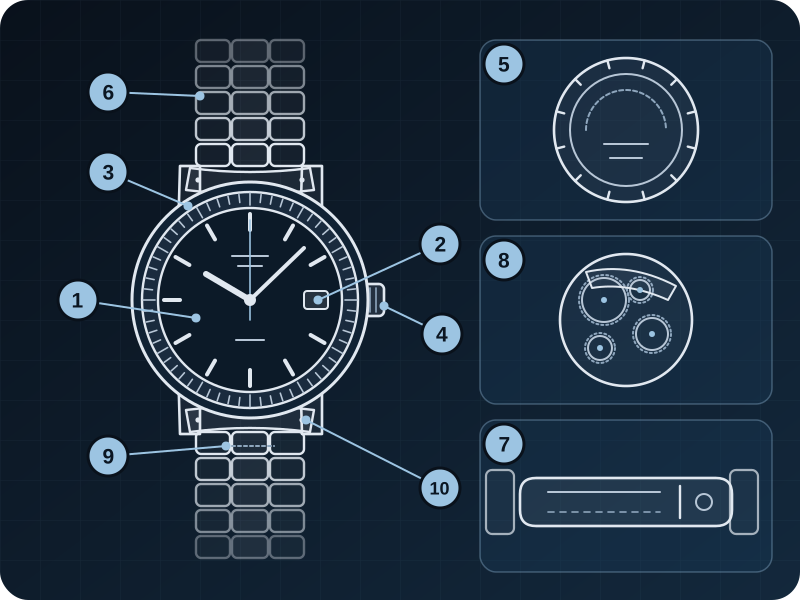
Dial Front
Capture the watch face straight on so dial printing, logo placement, markers, hands, bezel, and crystal condition are visible.
Dial Close-up
Show fine dial details such as typography, indices, date window, texture, lume, hands, and crystal clarity.
Case Detail
Photograph case finishing, lug shape, bezel edge, brushing, polishing, engraving, and wear condition close up.
Crown / Side Profile
Capture the crown, pushers, case thickness, side profile, bezel height, and side finishing clearly.
Case Back
Show the case back, engravings, reference numbers, serial marks, screws, and overall back-side construction.
Bracelet / Strap
Show bracelet links, end links, leather texture, stitching, taper, fit, and material wear.
Clasp / Buckle
Capture clasp shape, engravings, buckle hardware, screws, stamps, and metal finishing in sharp focus.
Inner Construction
Include the movement, inner case, open case back, bracelet interior, or construction details when available.
Serial / Reference Detail
Photograph serial numbers, reference marks, clasp codes, hallmarks, or production markings clearly.
Watch Detail
Show hallmarks, engravings, screws, hinge joints, end links, finishing, or wear marks in sharp close-up.
Follow the same angles in the app
The Vereev app shows a sample photo for each angle when you submit a Patek Philippe watch. Sharp, same-item photos give the reviewer the evidence this page describes; packaging and documents help when you have them.
See the app's 10 sample photos for watchesBrand evidence guide
What to review on Patek Philippe items
Which Patek Philippe collection and reference are you checking?
Patek's current collections include Grand Complications, Complications, Calatrava, Gondolo, Golden Ellipse, Cubitus, Nautilus, Aquanaut, Twenty~4, Pocket Watches and Rare Handcrafts. Each watch is sold under a reference, such as 5811/1G-001 for a white gold Nautilus or 5167A-001 for a steel Aquanaut, and details differ between references in the same family.
Each watch also has its own numbers. Patek says the Certificate of Origin delivered with every new watch gives the movement, case and reference numbers, and that the movement number is engraved in the movement while the case number is engraved inside the case back.
Match every claim in a listing to Patek's page for the exact reference, including the movement type. For example, Patek lists the Twenty~4 4910/1200A-010 with the quartz caliber E15 and the Nautilus 5811/1G-001 with the self-winding caliber 26-330 S C.
- Collection and full reference, matched to Patek's listing where possible
- Case material and size
- Dial, bezel, bracelet or strap and clasp
- Case back type, sapphire crystal or solid
- Certificate of Origin, any Extract from the Archives and service invoices
- Purchase source, date and any service or modification history
What to compare on the case, bezel, dial and bracelet
Patek's own descriptions are the first test. It describes the Nautilus, launched in 1976, by its rounded octagonal bezel, a case construction inspired by a ship's porthole and a horizontally embossed dial, and the Aquanaut, which debuted in 1997, by a case and rounded octagonal bezel that recall the Nautilus, an embossed pattern that runs from the dial to the strap and a composite strap. The Calatrava began in 1932 with Ref. 96 as a round watch, and Patek says the bezel of Ref. 6119 carries a hobnail or Clous de Paris pattern.
Reviewers then compare dial printing, markers, hands, date window, bezel finish, case profile, crown, bracelet links and clasp with well-documented examples of the same reference. The RealReal and 1stDibs both advise confirming that the crown and any chronograph pushers actually work.
Allow for legitimate variation. Service parts, polishing that softens case edges, replacement straps and aging on older watches all change how a genuine watch looks, so a difference needs an explanation rather than an instant verdict.
Where are the movement and case numbers, and what does the Seal show?
Patek says the case back must be removed to see the movement number, which is engraved in the movement, and that the case number is engraved on the inside of the case back. It advises that only an Authorized Retailer or Authorized Service Center should remove the case back of a wristwatch or pocket watch.
The RealReal and 1stDibs both note that serial and reference numbers should not appear on the outside of a Patek case back, which fits Patek's own description. Numbers engraved on the outside of a case back therefore need an explanation.
The Patek Philippe Seal is the brand's own quality standard, which Patek says it created in 2009, applies to all its mechanical timepieces and affixes prominently on the movement, for example on a bridge. Its 2009 announcement said the Seal would gradually replace the Geneva Seal on its movements, and because a hallmark can be imitated, the Seal seen through a sapphire case back is one detail to compare with the reference and its era.
What the Certificate of Origin and Extract from the Archives confirm
Patek says the Certificate of Origin is delivered with every new watch, gives the movement, case and reference numbers and serves as a warranty. It also says the certificate can never be reissued and that no copy can ever be provided, and it suggests that owners contact the official retailer that sold the watch for assistance.
For watches first sold at least ten years before the request, Patek offers an Extract from the Archives through its online order form, and when this page was researched in September 2026 it gave the fee as 500 Swiss francs. Patek says the Extract gives details such as the caliber, movement number, case number, dial type, bracelet or strap type, date of completion and date of sale, and that it needs photos to check the watch's visual compliance with its archive journals.
Patek states that the Extract is neither a proof of authenticity nor a warranty document. Both documents describe numbers and records, so they help only when every number and detail matches the watch in front of you.
What about modified, serviced or restored watches?
Patek says the Extract describes a watch in its original state. If Patek itself modified the watch and recorded the change in its journals, the Extract describes the later modification too, but Patek says modifications made outside its workshops cannot be taken into account, and in that case an Extract cannot be issued.
Patek pledges to service, repair or restore any Patek Philippe timepiece regardless of its age, and says all its timepieces must be serviced by authorized retailers or authorized service centers only. It also says an Extract cannot be processed while the watch is being serviced.
Ask the seller what service was done, by whom and what was replaced or added, such as gem setting or a different dial, and keep service invoices with the watch.
Where to buy a Patek Philippe and what Patek will and will not do
Patek says all its sales are handled exclusively by its distribution network, and that a retailer or service center not listed in its official databases is not an authorized Patek Philippe retailer. Check a seller's claim to be authorized against Patek's own points-of-sale locator.
Patek's FAQ says it cannot provide resale values and suggests an auction house or a dealer specialized in older timepieces. It also describes how an owner can ask it to register a stolen watch with an official crime report that gives the theft reference number and the watch serial number.
For pre-owned and private sales, the watch has to carry the evidence. Use protected payment, ask for current photos and video of the actual watch, and confirm that the delivered watch matches what was reviewed.
When should you get an item-level Patek Philippe review?
Get a review when the price, seller history or photos leave doubt, when the watch has been serviced or modified, or when a listing leans on papers, a box or an Extract instead of the watch itself.
Submit sharp photos of the dial, case sides, crown, bezel, case back, clasp, bracelet or strap, the movement through a sapphire case back and every document, plus a short video of the watch running. A Vereev reviewer compares them with the same reference and notes what photos cannot show, such as numbers inside a solid case back.
Model-specific checks
Most-searched Patek Philippe models
Compare each piece with references for the same version, size, and period. These are the details a reviewer photographs and compares first.
Nautilus
Patek describes the Nautilus, launched in 1976, by its rounded octagonal bezel, porthole-inspired case construction and horizontally embossed dial, and its current listings include several versions such as the white gold 5811/1G-001. It is a frequent subject of real-versus-fake questions, so a listing must be matched to its exact reference.
Check and photograph
- Full reference, since Patek lists several Nautilus versions such as 5811/1G-001, 5712/1R-001 and 5980/60G-001
- Rounded octagonal bezel, case profile and how the bracelet meets the case
- Horizontally embossed dial, markers, hands and date aperture against the exact reference
- Sapphire crystal case back where the reference has one, as on 5811/1G-001, and the self-winding caliber and Seal visible through it
- Bracelet and fold-over clasp, with any aftermarket gem setting disclosed
Aquanaut
Patek says the Aquanaut debuted in 1997 with a case and rounded octagonal bezel that recall the Nautilus, an embossed pattern that runs from the dial to the strap, and a composite strap made to resist wear, salt water and UV radiation. It also draws real-versus-fake questions.
Check and photograph
- Full reference and material, such as the steel 5167A-001 or the white gold 5168G-001
- Embossed dial pattern and how it continues on the strap
- Composite strap and fold-over clasp against the reference
- Sapphire crystal case back and movement, which Patek's current 5167A-001 listing gives as the self-winding caliber 26-330 S C, with the production year in mind
- Case size, which Patek gives for 5167A-001 as 40.8 mm measured from 10 to 4 o'clock
Calatrava
Patek says the Calatrava began in 1932 with Ref. 96 as a round watch with pure lines inspired by Bauhaus principles, and that the bezel of Ref. 6119 carries a hobnail or Clous de Paris pattern. Its simple design means proportions, dial printing and finishing carry much of the evidence.
Check and photograph
- Full reference and case material, such as 5226G-001, 6119R-001 or 6007G-010
- Bezel finish, including the hobnail pattern on Ref. 6119
- Dial printing, markers and hands against the exact reference
- Case back type and any movement or Seal visible through it
- Crown function and the fit of the strap and buckle
Warning signs
When Patek Philippe items need a closer look
Each sign is a reason to ask more questions or get an item-level review. None is a verdict on its own.
- The movement or case numbers on the Certificate of Origin or an Extract do not match the watch, or the seller will not have them checked by an authorized retailer or service center.
- Serial or reference numbers are engraved on the outside of the case back, although Patek says the case number is engraved on the inside of it.
- The case, bezel, dial pattern, case back type or movement type does not match Patek's listing for the claimed reference.
- The crown or chronograph pushers do not work as they should.
- A seller claims to be an authorized Patek Philippe retailer but does not appear in Patek's official points-of-sale locator.
- Aftermarket changes, replaced parts or undisclosed service are visible, which matters because Patek says it cannot issue an Extract for a watch modified outside its workshops.
- The seller offers papers, a box or an Extract as proof but will not show the case back, clasp, dial close-ups and current video of the watch.
- The price is well below comparable watches of the same reference and condition, or the seller presses for fast or off-platform payment.
Research library
Patek Philippe tools and guides
Category guide
Watch Authentication
See how reference, exterior, number, service and provenance evidence work together for luxury watches.
Open resourceOfficial code guide
Patek Philippe Extract from the Archives
What the Extract and Certificate of Origin contain, how an Extract is ordered, and why Patek says it is not proof of authenticity.
Open resourcePhoto preparation
Authentication Image Guidelines
Prepare complete same-item views and sharp category-specific close-ups before submitting.
Open resourceEvidence standard
Vereev Authentication Methodology
See how Vereev weighs multiple signals, records limits, and avoids treating one code or logo as a verdict.
Open resourceCommon questions
Patek Philippe authentication FAQ
How can I tell if my Patek Philippe is real?
Identify the exact reference, then compare the case, bezel, dial, bracelet or strap and any visible movement with Patek's listing, and check that the numbers on the papers match the watch. No single detail decides it, and the numbers inside the case need an authorized retailer or service center to open the case back.
Where is the serial number on a Patek Philippe?
Patek says the movement number is engraved in the movement and the case number on the inside of the case back, so the case back has to be removed to see them. Patek advises that only an Authorized Retailer or Authorized Service Center should do this.
Can I look up a Patek Philippe serial number?
The Patek FAQ pages reviewed here do not describe a public serial-number lookup. For watches first sold at least ten years ago, Patek offers a paid Extract from the Archives, which it says is neither a proof of authenticity nor a warranty document.
What if a pre-owned Patek Philippe has no Certificate of Origin?
Patek says a Certificate of Origin can never be reissued and directs owners to the official retailer that sold the watch. A missing certificate is not a verdict, but it removes one layer of context, so the watch itself has to carry more of the evidence.
Does the Patek Philippe Seal prove a watch is real?
No. Patek describes the Seal as its own quality standard for its mechanical watches, affixed on the movement, but a hallmark can be imitated, so it is one detail to compare with the reference and its era.
Will Patek Philippe tell me what my watch is worth?
No. Patek's FAQ says it cannot provide resale values and suggests contacting an auction house or a dealer specialized in buying and selling older timepieces.
Sources and further reading
Evidence behind this guide
- Patek Philippe official Extract from the Archives FAQOfficial brand source
- Patek Philippe official FAQ on the Extract and Certificate of OriginOfficial brand source
- Patek Philippe official watch authenticity FAQOfficial brand source
- Patek Philippe official page on the Patek Philippe SealOfficial brand source
- The RealReal guide to spotting a real Patek PhilippeEstablished secondary source
- 1stDibs guide to spotting a fake Patek PhilippeEstablished secondary source
Related brand research
Authentication guides for related brands
Evidence standard
Codes and tags are context, not verdicts
Vereev is independent of Patek Philippe and is not affiliated with or endorsed by the brand. Patek says its sales are handled only by its distribution network, and it offers an Extract from the Archives for watches first sold at least ten years ago, which it says is neither a proof of authenticity nor a warranty document.
Vereev is an independent authentication service and is not affiliated with, endorsed by, or sponsored by Patek Philippe.
Read our research methodology