
Researched Omega guide
Omega Authentication
How to tell if an Omega watch is real: reference checks, dial, crystal and caseback details, serial and warranty card, Master Chronometer and archive facts.
Direct answer
To tell if an Omega is real, identify the exact collection and reference, then compare dial, hands, crystal, bezel, case, caseback and bracelet with Omega's listing for that reference. Omega says authentic watches come with a warranty card showing the serial number, reference, purchase date and retailer, and current watches carry the serial on the back or a lug. Serials, cards, Master Chronometer results and archive extracts are supporting context that must agree with the watch, not proof.
Omega Serial Number and Extract of the ArchivesComplete review
How to approach Omega authentication
Collection, reference and version
Name the collection and full reference, such as Speedmaster Moonwatch Professional 310.30.42.50.01.001, and record case size, material, dial, crystal, caseback and bracelet before comparing details.
Dial, crystal, bezel and caseback
Compare the dial, hands, crystal, bezel, caseback and bracelet with Omega's specifications for that exact reference, allowing for genuine service parts, polishing and wear.
Serial number and warranty card
Check that the serial engraved on the caseback or lug matches the warranty card, which Omega says carries the serial, reference, purchase date and the retailer's name and address.
Photos that settle the question
Photograph the dial straight on and at an angle, both case sides, crown, lugs, caseback, clasp, bracelet, engraved serial and papers, plus a short video of the watch running.
Photo guide
Photos to take of your Omega watch
The Vereev app's photo guide for watches lists these 10 angles, and the numbers on the drawing match the list.
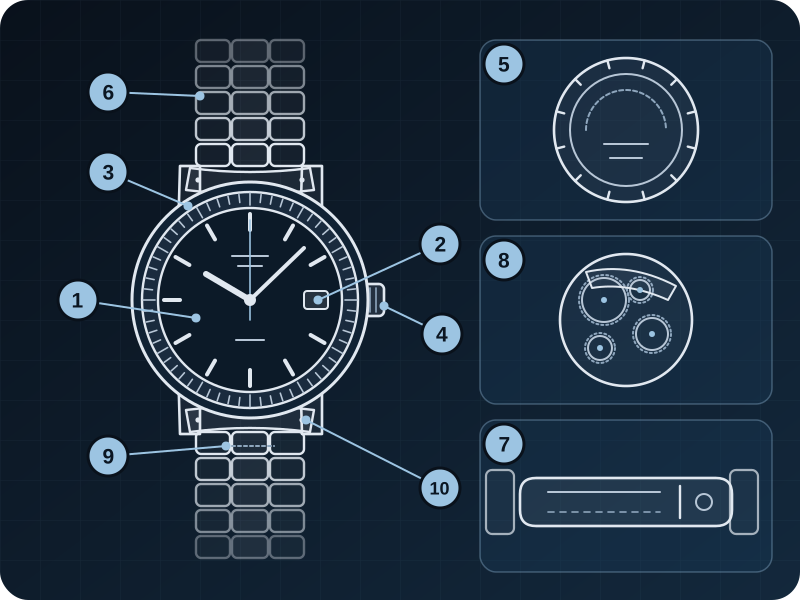
Dial Front
Capture the watch face straight on so dial printing, logo placement, markers, hands, bezel, and crystal condition are visible.
Dial Close-up
Show fine dial details such as typography, indices, date window, texture, lume, hands, and crystal clarity.
Case Detail
Photograph case finishing, lug shape, bezel edge, brushing, polishing, engraving, and wear condition close up.
Crown / Side Profile
Capture the crown, pushers, case thickness, side profile, bezel height, and side finishing clearly.
Case Back
Show the case back, engravings, reference numbers, serial marks, screws, and overall back-side construction.
Bracelet / Strap
Show bracelet links, end links, leather texture, stitching, taper, fit, and material wear.
Clasp / Buckle
Capture clasp shape, engravings, buckle hardware, screws, stamps, and metal finishing in sharp focus.
Inner Construction
Include the movement, inner case, open case back, bracelet interior, or construction details when available.
Serial / Reference Detail
Photograph serial numbers, reference marks, clasp codes, hallmarks, or production markings clearly.
Watch Detail
Show hallmarks, engravings, screws, hinge joints, end links, finishing, or wear marks in sharp close-up.
Follow the same angles in the app
The Vereev app shows a sample photo for each angle when you submit an Omega watch. Sharp, same-item photos give the reviewer the evidence this page describes; packaging and documents help when you have them.
See the app's 10 sample photos for watchesBrand evidence guide
What to review on Omega items
Which Omega collection and reference are you checking?
Start with the collection and the full reference. Omega's references use a fourteen-digit Long Product Identification Code, and its FAQ breaks one down for a De Ville Ladymatic 34 mm, so a reference such as 310.30.42.50.01.001 points to one specific Speedmaster Moonwatch Professional version.
Omega's own listings include several versions inside one family. Its steel Moonwatch Professional listings include 310.30.42.50.01.001, 310.32.42.50.01.001 and 311.30.42.30.01.005, and its Seamaster Diver 300M listings include references in both the 210.30 and 210.32 series, so compare a watch only with the listing for its exact reference.
The serial number is a different thing. Omega says it appears on the warranty card given at purchase and is engraved on the back of current watches or on one of the lugs.
- Collection and model, such as Speedmaster, Seamaster, Constellation or De Ville
- Full reference and case size, matched to Omega's listing where possible
- Case material, dial color, crystal, caseback type and bracelet or strap
- Serial number and where it is engraved
- Purchase source, date and any service or repair history
What to compare on the dial, crystal, bezel, case and bracelet
Omega's product pages specify each reference they cover, and those specifications are the first test of a listing. For example, Omega lists the Moonwatch Professional 310.30.42.50.01.001 with a Hesalite crystal carrying an Omega logo in the center and an anodized aluminum tachymeter bezel ring, while the Seamaster Diver 300M 210.30.42.20.01.001 has a black ceramic bezel with a white enamel diving scale, a polished black ceramic dial with laser-engraved waves and a transparent caseback.
Reviewers then compare dial printing, hands, indexes, date window, crown, lugs, caseback, bracelet links and clasp with well-documented examples of the same reference. Crystal type and whether the caseback is solid or transparent are quick ways to test a listing against its claimed reference.
Allow for legitimate variation. A genuine watch can carry later service parts, polishing softens case edges and vintage watches age, so a difference needs an explanation rather than an instant verdict.
Where is the Omega serial number and what should the warranty card show?
Omega says the serial number and case number are on the warranty card given at purchase, and that the serial number is engraved on the back of current watches or on one of the lugs. For vintage watches, Omega says this information is usually engraved inside the caseback and on the movement, which means opening the watch.
Omega's authenticity FAQ says authentic watches are supplied with a warranty card completed with an 8-digit numeric or 7-digit alphanumeric serial number, the watch reference, the purchase date and the retailer's full name and address. Omega's FAQ also says the 5-year International Warranty on new watches is valid only when the warranty certificate is dated, fully and correctly completed and stamped by an authorized Omega retailer.
A card is supporting context, not proof. Cards can be copied, filled in for another watch or separated from the watch they came with, so the serial and reference on the card must match the engraving and the watch itself.
- Photograph the engraved serial on the caseback or lug in focus and without glare.
- Photograph both sides of the warranty card and any receipt, covering personal details if you need to.
- Check that the serial, reference, date and retailer on the card are complete and consistent.
- Leave vintage caseback and movement checks to a qualified watchmaker.
What Omega says about the movement, Master Chronometer and magnets
Omega's authenticity FAQ points to the movement, noting that components such as the Co-Axial escapement wheel are exclusive to the brand. The movement sits behind the caseback, so beyond what a transparent caseback shows, movement questions belong with a qualified watchmaker or Omega service.
For Master Chronometer watches, Omega says the movement withstands magnetic fields of up to 15,000 gauss, and its FAQ says a Master Chronometer keeps working normally near a magnet while a fake stops ticking. Omega also says owners can see a watch's Master Chronometer test results by entering the information on its Master Chronometer card on Omega's website.
Use these checks with care. They apply only to Master Chronometer references, Omega advises keeping other Omega watches away from high magnetic fields, and a watch that keeps running or a card that returns results still needs its case, dial, bracelet and papers to agree.
What the Extract of the Archives and Certificate of Authenticity cover
Omega lists certificates and extracts in the customer service section of its website. When Omega introduced its Certificate of Authenticity in 2019, the Federation of the Swiss Watch Industry reported that the Extract from the Archives gives information about when a watch was produced, while the certificate gives extended information about the authenticity of a watch in its current condition.
The same report said the certificate was offered for Omega watches over 30 years old, presented at Omega's headquarters in Switzerland or a participating boutique and inspected by the Omega Heritage team. Watchonista reported in 2021 that the Extract does not include a physical inspection and that only watches with all their original parts are eligible for the certificate.
So an Extract reflects Omega's production records for the watch named in the request, not proof that the watch in front of you is that watch or that its parts are original. Check Omega's Certificates and extracts page for current eligibility, fees and timing before relying on either document.
Where to buy an Omega and what Omega will and will not do
Omega says to buy only from an Omega Boutique or an Omega authorized retailer, and calls its online shop, where available, a secured purchase channel. It warns that counterfeits are often offered on unreliable websites and that watches bought from unauthorized sources might be damaged or counterfeit and may not benefit from a warranty.
Omega's FAQ also says it does not assess the value of pre-owned watches, and that a watch is eligible for service when it is built entirely with matching Omega parts. Its warranty excludes watches handled by an unauthorized person or altered from their original condition beyond Omega's control.
For pre-owned and private sales, the watch has to carry the evidence. Use protected payment, ask for current photos and video of the actual watch, and confirm that the delivered watch matches what was reviewed.
When should you get an item-level Omega review?
Get a review when the price, seller history or photos leave doubt, when the watch has been serviced or modified, or when a listing leans on a card, box or magnet video instead of the watch itself.
Submit sharp photos of the dial, case sides, crown, lugs, caseback, clasp and bracelet, the engraved serial and the warranty card, plus a short video of the watch running. A Vereev reviewer compares them with the same reference and notes what photos cannot show, such as the movement behind a solid caseback.
Model-specific checks
Most-searched Omega models
Compare each piece with references for the same version, size, and period. These are the details a reviewer photographs and compares first.
Speedmaster Moonwatch Professional
Omega says the Speedmaster was part of all six Moon landings and that the Moonwatch Professional is inspired by the fourth-generation Speedmaster style worn on the Moon, and it lists the Master Chronometer version 310.30.42.50.01.001 with the manual-winding caliber 3861. Its fame and several similar references make it a frequent subject of real-versus-fake questions.
Check and photograph
- Full reference, since Omega lists several steel versions such as 310.30.42.50.01.001 and 310.32.42.50.01.001
- Crystal type, since Omega lists 310.30.42.50.01.001 with a Hesalite crystal carrying an Omega logo in the center
- Tachymeter bezel ring, listed as anodized aluminum on 310.30.42.50.01.001, and its printing and alignment
- On 310.30.42.50.01.001, the brushed bracelet with five arched links per row, foldover clasp and fit at the lugs
- Caseback, serial engraving and the movement claim, with movement questions left to a watchmaker
Seamaster Diver 300M
Omega lists the 42 mm steel Diver 300M 210.30.42.20.01.001 with a black ceramic bezel and white enamel diving scale, a polished ceramic dial with laser-engraved waves, a conical helium escape valve and the self-winding caliber 8800. It is a frequent subject of real-versus-fake questions.
Check and photograph
- Ceramic bezel and enamel diving scale against the exact reference
- Laser-engraved wave dial, date window at 6 o'clock, skeleton hands and raised indexes, where the reference has them
- Helium escape valve shape and position against the same reference
- Caseback type, such as the transparent wave-edged caseback on 210.30.42.20.01.001, and any movement visible through it
- Bracelet and foldover clasp with diver extension, where the reference has them
Seamaster Aqua Terra 150M
The Aqua Terra 150M belongs to the Seamaster family, and Omega lists the 41 mm Master Chronometer version 220.10.41.21.01.001 with a horizontal teak-pattern dial inspired by sailboat decks, a transparent caseback and the self-winding caliber 8900. A listing must be matched to its exact version.
Check and photograph
- Horizontal teak-pattern dial, color and printing against the exact reference
- Date window at 6 o'clock and rhodium-plated hands and indexes with Super-LumiNova, where the reference has them
- Transparent caseback, where the reference has one, and the movement visible through it
- Butterfly clasp and bracelet fit
- Case size and reference, matched to Omega's listing
Warning signs
When Omega items need a closer look
Each sign is a reason to ask more questions or get an item-level review. None is a verdict on its own.
- The serial on the warranty card does not match the serial engraved on the caseback or lug, or the card is missing the reference, purchase date or retailer details.
- Crystal, bezel, dial or caseback details do not match Omega's listing for the claimed reference, such as the wrong crystal type or a solid caseback where the reference has a transparent one.
- A transparent caseback shows a movement that does not match the caliber Omega lists for the reference.
- The seller offers a magnet video, card scan or test-result screenshot as proof but will not show the caseback, lugs, clasp and dial close-ups.
- The listing uses stock images or photos of another watch instead of current photos and video of the actual watch.
- Service, polishing, replaced parts or aftermarket modifications are visible but not disclosed or documented.
- The price is well below comparable watches of the same reference and condition, especially with pressure to pay quickly or off-platform.
Research library
Omega tools and guides
Category guide
Watch Authentication
See how reference, exterior, serial, service and provenance evidence work together for luxury watches.
Open resourceOfficial code guide
Omega Serial Number and Extract of the Archives
Where Omega serials are, what the warranty card shows, and what an Extract or certificate does and does not cover.
Open resourcePhoto preparation
Authentication Image Guidelines
Prepare complete same-item views and sharp category-specific close-ups before submitting.
Open resourceEvidence standard
Vereev Authentication Methodology
See how Vereev weighs multiple signals, records limits, and avoids treating one code or logo as a verdict.
Open resourceCommon questions
Omega authentication FAQ
How can I tell if my Omega watch is real?
Identify the exact reference, then compare dial, hands, crystal, bezel, case, caseback and bracelet with Omega's listing for it and check that the engraved serial matches the warranty card. No single detail decides it, and movement questions need a qualified watchmaker.
Where is the serial number on an Omega watch?
Omega says it is on the warranty card and engraved on the back of current watches or on one of the lugs. On vintage watches, Omega says it is usually engraved inside the caseback and on the movement.
Can I look up an Omega serial number to see if it is real?
Omega's FAQ does not describe a public serial-number lookup for authenticity. Master Chronometer owners can view test results with the information on their Master Chronometer card, and a serial or card can be copied, so both have to agree with the watch.
Does the magnet test work on an Omega?
Omega's FAQ says a Master Chronometer keeps working normally near a magnet while a fake stops ticking, but that applies only to Master Chronometer watches. Omega advises keeping other Omega watches away from high magnetic fields, and a running watch still needs its case, dial and papers to agree.
What is the Omega Extract of the Archives?
Published reports describe it as a record of when a watch was produced, drawn from Omega's archives, and Watchonista reported that it involves no physical inspection. Reports in 2019 said Omega's separate Certificate of Authenticity was for watches over 30 years old and followed an inspection of the watch's current state.
Do the box and papers prove an Omega is real?
No. Boxes, warranty cards and receipts can be copied or separated from the watch they came with, so they only help when their serial and reference match the exact watch.
Sources and further reading
Evidence behind this guide
- Omega official FAQ on brand and product informationOfficial brand source
- Omega official FAQ on buying an Omega productOfficial brand source
- Omega official Speedmaster Moonwatch Professional 310.30.42.50.01.001 pageOfficial brand source
- Omega official Seamaster Diver 300M 210.30.42.20.01.001 pageOfficial brand source
- Federation of the Swiss Watch Industry report on Omega's Certificate of AuthenticityEstablished secondary source
- Watchonista report on Omega's Heritage department and certificateEstablished secondary source
Related brand research
Authentication guides for related brands
Evidence standard
Codes and tags are context, not verdicts
Vereev is independent of Omega and is not affiliated with or endorsed by the brand. Omega says to buy from its boutiques, authorized retailers or, where available, its online shop, and lists archive extracts and certificates among its customer services, which an independent photo review does not replace.
Vereev is an independent authentication service and is not affiliated with, endorsed by, or sponsored by Omega.
Read our research methodology